Lemma 20.6.1. Let
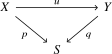 be a commutative triangle of simplicial animae.
We assume that, in any anima context, for any
map \(\sigma\colon\Delta^n\to S\), the induced map of type
\[
\Delta^n\times_SX\to\Delta^n\times_SY
\]
induces an isomorphism in \(\An\) after geometric realization.
Then the geometric realization of \(u\) is an isomorphism.
Proof
Our assumptions mean that, for any small anima \(\Gamma\) and any term \(n : \N\), for any map of the form \(\sigma\colon\Gamma\times\Delta^n\to S\), the induced map of type \[ \sigma^*(u)\colon(\Gamma\times\Delta^n)\times_SX\to(\Gamma\times\Delta^n)\times_SY \] induces an isomorphism in \(\An\) after geometric realization. But any simplicial anima is canonically a colimit of simplicial animae of the form \(\Gamma\times\Delta^n\). Furthermore, for any morphism \(f\colon A\to S\) in \(\PSh(\Delta)\), the pullback \[ f^*\colon\PSh(\Delta)_{/S}\to\PSh(\Delta)_{/A} \] has a right adjoint: we can identify \[ \PSh(\Delta)_{/S}=\PSh(\Delta_{/S}) \] so that \(f^*\) is the pullback functor along the functor \[ f_!\colon\Delta_{/A}\to\Delta_{/S}\, . \] In particular, the functor \(f^*\) commutes with colimits. Therefore, the map \(u\) is canonically a colimit of morphisms of the form \(\sigma^*(u)\) induced by pullbacks from maps \(\sigma\) as above. Since the realization functor commutes with colimits (this is a colimit functor itself by definition), the geometric realization of \(u\) is the colimit of the geometric realization of each of the \(\sigma^*(u)\)’s. We conclude by the obvious observation that colimits preserve isomorphisms.