Theorem 19.4.3. Let \(f\colon C\to D\) be an exact functor between locally small stable categories. Then \(f\) has a right adjoint \(g\colon D\to C\) if and only if there is a functorial isomorphism of spectra \[ \SpHom_D(f(x),y)=\SpHom_C(x,g(y)) \] for any \(x : C\) and any \(y : D\).
Proof
This is clearly a sufficient condition since one can recover \(\Hom\) from \(\SpHom\) by applying \(\Omega^\infty\).
For the converse, we may choose to work in a universe for which both \(C\) and \(D\) are small.
The property that \(g\) is right adjoint to \(f\) is that \(g_!=f^*\), where
\[
f^*\colon\PSh(D)\to\PSh(C)
\]
is the functor defined by precomposition by \(f\catop\) whereas
\[
g_!\colon\PSh(D)\to\PSh(C)
\]
extends \(g\) by small colimits along the Yoneda embedding.
By virtue of Theorem 18.2.8, these identifications
remain true when we restrict ourselves to ind-objects.
We thus get identifications of the form \(g_!=f^*\) where this time we consider functors
\[
f^*, g_!\colon\Fun(D\catop,\Sp)\to\Fun(C\catop,\Sp)\,.
\]
Since we have a canonical commutative square of the form
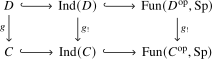 we must have
\[
g_!(\SpHom_D(-,y))=\SpHom_C(-,g(y))
\]
for all \(y : D\). Since
\[
f^*(\SpHom_D(-,y))=\SpHom_D(f(-),y)
\]
holds by definition, this proves the theorem.
From Section 19.4, Representable presheaves on stable categories.