Theorem 19.3.4. Let \(A\) and \(B\) be two stable categories, and \(\varphi\colon A\to B\) be a functor. The following assertions are equivalent.
(i) The functor \(\varphi\) is right exact.
(ii) The functor \(\varphi\) is left exact.
(iii) The functor \(\varphi\) preserves initial objects and cofiber sequences.
(iv) The functor \(\varphi\) preserves terminal objects and fiber sequences.
Proof
It is clear that any left exact functor preserves fiber sequences by definition.
Let us assume condition (iv) to hold and prove that \(\varphi\) is left exact. We just have to prove that
it preserves pullbacks.
Let
 be a pullback square in \(A\).
We extend it by forming the fiber of \(f'\).
 We then get a commutative diagram in \(B\) of the form
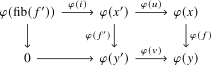 in which the outer square as well as the square on the left both are pullback squares.
But \(B\) being stable these are pushout squares as well.
This implies that the square on the right is a pushout square, hence a pullback square as well.
In other words conditions (i) and (iii) are equivalent and conditions (ii) and (iv)
are equivalent.
It suffices now to prove that conditions (iii) and (iv) are equivalent. This follows from the fact that in any stable category, the collection of initial objects coincides with the collection of terminal objects, and that the collection of cofiber sequences agrees with the collection of fiber sequences.
From Section 19.3, Exact functors between stable categories.