Construction 20.3.3. Given a pre-Waldhausen categories \(A\) and \(B\), we write \(\Wald(A,B)\) for the full subcategory of
\(\Fun(A,B)\) whose objects are morphisms of pre-Waldhausen categories.
In fact \(\Wald(A,B)\) is a Waldhausen category itself: one defines weak equivalences as the
natural transformations between morphisms of Waldhausen categories
\[
\alpha\colon f\to g
\]
such that \(\alpha_x\colon f(x)\to g(x)\) is a weak equivalence for any object \(x : A^\simeq\).
Cofibrations are those natural transformations between morphisms of Waldhausen categories
\[
\alpha\colon f\to g
\]
with the property that, for any cofibration \(i\colon x\to y\) in \(A\), the induced commutative
square
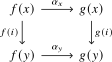 induces a cofibration of type \(f(y)\amalg_{f(x)}g(x)\to g(y)\) (the stability of these cofibrations under pushouts follows straight away from the preceding lemma).
A particular case of interest is \(A=[0]\star[1]\) for some \(n : \N\).
A morphism \([0]\star[1]\to B\) literally is a commutative triangle of the form
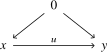 with \(u\) a cofibration. There is thus an equivalence from \(\Wald([0]\star[1],B)\) to the full subcategory
of \(\Fun([1],B)\) whose objects are the cofibrations of \(B\). More generally, given \(n : \N\),
we define \(B^{[n]}\) as the full subcategory of \(\Fun([n],B)\) whose objects are sequences of
cofibrations of the form
\[
x_0\to\cdots\to x_n
\]
in \(B\), the assignment
\[
(x_0\to\cdots\to x_n)\mapsto(0\to x_0\to\cdots\to x_n)
\]
defines an equivalence
\[
B^{[n]}\simeq\Wald([0]\star [n],B)\, .
\]