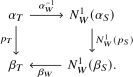
Example 5.1.4 (The pentagon). Consider four composable functors \(f\), \(g\), \(h\) and \(k\), as in Axiom A.8. The two paths around the pentagon determine identification expressions \[ \alpha \quad := \quad \alpha_{g \circ f, h,k} \cdot \alpha_{f,g,k \circ h}, \qquadtext{ and } \beta \quad := \quad (\id_k \star \alpha_{f,g,h}) \cdot \alpha_{f, h \circ g,k} \cdot (\alpha_{g,h,k} \star \id_f), \] providing identifications between \(((k \circ h) \circ g) \circ f\) and \(k \circ (h \circ (g \circ f))\). If we instantiate these four functors in theory \(S\), there are now four ways to obtain an identification \(((Wk \circ Wh) \circ Wg) \circ Wf = Wk \circ (Wh \circ (Wg \circ Wf))\) in theory \(T\):
\(\alpha_T\) Instantiate \(\alpha\) directly in theory \(T\), applied to the tuple \(WF = (Wf, Wg, Wh, Wk)\);
\(\beta_T\) Instantiate \(\beta\) directly in theory \(T\), applied to \(WF\);
\(N^1_W(\alpha_S)\) Instantiate \(\alpha\) in theory \(S\), apply \(W\), and compose with the previously constructed identifications of its source and target \begin{align*} W(((k \circ h) \circ g) \circ f) &= ((Wk \circ Wh) \circ Wg) \circ Wf \\ W(k \circ (h \circ (g \circ f))) &= Wk \circ (Wh \circ (Wg \circ Wf)). \end{align*}
\(N^1_W(\beta_S)\) Instantiate \(\beta\) in theory \(S\), apply \(W\), and compose with the same two identifications.
Theories \(S\) and \(T\) provide pentagon identifications \(p_S\colon \alpha_S=\beta_S\) and \(p_T\colon \alpha_T=\beta_T\). The coherence data \(p_W\colon N_W^2(p_S)=p_T\) that \(W\) needs to provide can then be interpreted as requiring the following square to commute: