Exercise 3.8.1. Consider a category \(\Gamma\), a category \(D\) and a category \(q\colon E\to\Gamma\) over
\(\Gamma\). Put \(D_\Gamma:=D\times\Gamma\to\Gamma\). Define a category
\(\ulFun_\Gamma(D_\Gamma,E)\) over \(\Gamma\) by the pullback square
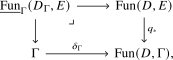 where \(\delta_\Gamma\) is the currying of the projection
\(\Gamma\times D\to\Gamma\). Show that this category has the universal property of the
relative functor category from \(D_\Gamma\) to \(E\) over \(\Gamma\).
Exercise 3.8.2. Prove Lemma 3.2.10: show that for embeddings \(\Gamma \hookrightarrow C^{\simeq}\) and \(\Lambda \hookrightarrow D^{\simeq}\) the projections \(C \times D \to C\) and \(C \times D \to D\) induce an equivalence \[ \langle \Gamma \times \Lambda \subseteq C \times D \rangle \iso \langle \Gamma \subseteq C \rangle \times \langle \Lambda \subseteq D \rangle. \]
Exercise 3.8.3. Prove the assertions from Remark 3.1.17: given a functor \(f\colon C \to D\) sending a collection of morphisms \(M\) in \(C\) to a collection of morphisms \(N\) in \(D\), we have:
(1) The map \(f\vert\colon \lra{M}_C \to \lra{N}_D\) is uniquely determined by \(f\).
(2) Given an identification \(f = f'\), we obtain an induced identification \(f\vert = f'\vert\).
(3) The construction is compatible with identities and composition: we have identifications \((\id_C)\vert = \id_{\lra{M}_C}\) and \((g \circ f)\vert = g\vert \circ f \vert\) if \(g\colon D \to E\) is another functor preserving a collection of morphisms.
(4) If the functors \(f\colon C \to D\) and \(\tilde{f}\colon M \to N\) are equivalences, then also \(f\vert\colon \lra{M}_C \to \lra{N}_D\) is an equivalence.
Exercise 3.8.4. Let \(W\) be a collection of morphisms in a category \(C\), and let \(l\colon C \to L\) and \(l'\colon C \to L'\) be two localizations of \(C\) at \(W\). Construct an equivalence \(L \iso L'\).
Exercise 3.8.5. Let \(W\) be a collection of morphisms in a category \(C\), and let \(C \to C[W^{-1}]\) be a localization of \(C\) at \(W\). Construct a pushout square
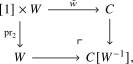 where the map \(\tilde{w}\) is obtained by uncurrying the composite \(W \xrightarrow{w} \Map([1],C) \to \Fun([1],C)\).
Exercise 3.8.6. Let \(p\colon S \to T\) be a functor, and let \(f\colon C \to S\) be a category over \(S\). Let \(g\colon D \to T\) and \(g'\colon D' \to T\) be categories over \(T\) that are both a dependent product of \(C\) along \(p\). Show that there is an equivalence \(D \iso D'\) of categories over \(T\) (in the sense of Definition 1.9.3).