Definition 7.1.1. Let \(I\) and \(C\) be categories. We refer to objects of the functor category \(\Fun(I,C)\) as \(I\)-indexed diagrams in \(C\). Given such a diagram \(F \in \Fun(I,C)\), we define the category \(C_{/F}\) of cones over \(F\) as the following relative slice category:
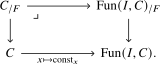 In other words, a cone over \(F\) consists of a pair \((x,\varepsilon)\) where \(x \in C\) and \(\varepsilon\colon \const_x \to F\) is a natural transformation. A cone \((x,\varepsilon)\) over \(F\) is called a limit cone if it is a terminal object of the cone category \(C_{/F}\). If it exists, a limit cone is unique. The underlying object \(x\) will then be called the limit of \(F\) and denoted by \(\lim(F)\), or \(\lim_I F\), or \(\lim_{i \in I} F(i)\).
Dually, we define a cocone under \(F\) to be an object of the dually defined category \(C_{F/}\). A colimit cocone is an initial object of \(C_{F/}\), and its underlying object, if it exists, will be denoted by \(\colim(F)\), or \(\colim_I F\) or \(\colim_{i \in I} F(i)\).
7.1.1 Examples
Throughout, we let \(C\) denote a category.
Observation 7.1.2. Consider the empty diagram \(I = \emptyset\). Then the category \(\Fun(\emptyset,C)\) is contractible by Lemma 1.7.14, providing a unique functor \(F\colon \emptyset \to C\). Observe that \(C_{/F} \simeq C \simeq C_{F/}\). So cones and cocones on \(F\) are simply given by objects \(x \in C\), and as a consequence we see:
• Terminal objects in \(C\) are the same as \(\emptyset\)-indexed limits.
• Initial objects in \(C\) are the same as \(\emptyset\)-indexed colimits.
Definition 7.1.3. Consider the two-point set \(I = \{0,1\} := * \sqcup *\). Then the two evaluation maps define an equivalence \((\ev_0,\ev_1)\colon \Fun(\{0,1\},C) \iso C \times C\), so that a functor \(\{0,1\} \to C\) is the same as a pair \((x,y)\) of objects of \(C\).
• A product of \(x\) and \(y\), denoted \(x \times y\), is a limit of the \(\{0,1\}\)-indexed diagram \((x,y)\).
• A coproduct of \(x\) and \(y\), denoted \(x \sqcup y\), is a colimit of the \(\{0,1\}\)-indexed diagram \((x,y)\).
Unwinding the definitions, we see that \(x \times y\) is terminal among objects equipped with maps \(\pr_x\colon x \times y \to x\) and \(\pr_y\colon x \times y \to y\). Dually, \(x \sqcup y\) is initial among objects equipped with maps \(x \to x \sqcup y\) and \(y \to x \sqcup y\).
Definition 7.1.4. We define categories \(\pullback\) and \(\pushout\) as follows: \[ \pullback \,\,:= \{0,1\} \star \,\ast \qquadtext{ and } \pushout \,\,:= \ast \,\star \{0,1\}, \] using the join operation from Axiom J.1.
The notations for these categories reflect the shape of the diagrams they classify: a functor \(\pullback \,\to C\) corresponds to a diagram in \(C\) of the form
 while a functor \(\pushout \,\to C\) corresponds to a diagram of the form
 More precisely, there are pullback squares

Definition 7.1.5. Consider a \(\pullback\)-indexed diagram \(x \xrightarrow{f} z \xleftarrow{g} y\) in \(C\). We refer to its limit as the pullback of \(f\) and \(g\), and denote it by \(x \times_z y\).
Dually, given a \(\pushout\)-indexed diagram \(x \xleftarrow{f} z \xrightarrow{g} y\), we refer to its colimit in \(C\) as the pushout of \(f\) and \(g\), and denote it by \(x \sqcup_z y\).