So far, we have introduced functors and their identifications, but we have essentially no relations between them. We next specify the coherence relations we will use. We first describe composition of identifications and its compatibility with whiskering. We then introduce the unit and associativity identifications for composition of functors, and the relations among them.
For readability, we write most of these coherences in their ‘term notation’, cf. Notation 1.1.3. In each case, the axiom introduces a specified identification of functors, which we will often leave nameless to avoid cluttering of notation.
1.2.1 Composition of identifications
Identifications can be composed: given identifications \(\sigma:f=g\) and \(\tau:g=h\), we obtain an identification \(\tau\circ\sigma:f=h\). We call this vertical composition to distinguish it from the horizontal composition introduced below. Every functor has an identity identification, and every identification has an inverse.
Axiom A.3 (Composition of identifications). For every functor \(f\), there is an identity identification \(\id_f\colon f= f\). For parallel functors \(f,g,h\colon C\to D\), there is a composition functor \[ -\circ-\colon(g= h)\times(f= g)\longrightarrow(f= h). \] There is also an inverse functor \[ (-)^{-1}\colon(f=g)\to(g=f). \] This composition is unital and associative, and the inverse functor supplies two-sided inverses, through specified identifications of functors on the corresponding animae of identifications. For \(\alpha:f=g\), \(\beta:g=h\), and \(\gamma:h=k\), where \(k\colon C\to D\), these laws read \[ \id_g\circ\alpha=\alpha,\qquad \alpha\circ\id_f=\alpha, \] \[ (\gamma\circ\beta)\circ\alpha=\gamma\circ(\beta\circ\alpha), \] \[ \alpha^{-1}\circ\alpha=\id_f,\qquad \alpha\circ\alpha^{-1}=\id_g. \]
The displayed laws are specified identifications of functors on the relevant animae of inputs. For parallel functors \(f,g,h,k\colon C\to D\), the associativity law compares the two functors \[ (h=k)\times\bigl((g=h)\times(f=g)\bigr)\longrightarrow(f=k) \] given by \((\gamma,(\beta,\alpha))\mapsto(\gamma\circ\beta)\circ\alpha\) and \((\gamma,(\beta,\alpha))\mapsto\gamma\circ(\beta\circ\alpha)\). Precomposing these comparisons with a functor into the input anima gives the same laws for the resulting expressions.
We can now also speak of commutative squares, triangles, and more general diagrams of identifications, using the convention of Definition 1.1.4 with vertical composition along their boundaries.
1.2.2 Whiskering and horizontal composition
Whiskering composes an identification with a functor on either side. We first require that it respect identity identifications and vertical composition.
Axiom A.4 (Whiskering and vertical composition). Prewhiskering and postwhiskering preserve identity identifications and vertical composition through specified identifications of functors on the input animae of identifications. For functors \(f,g,h\colon C\to D\), \(k\colon B\to C\) and \(u\colon D\to E\), these laws read \[ u\star\id_f=\id_{u\circ f},\qquad \id_f\star k=\id_{f\circ k}, \] \[ u\star(\tau\circ\sigma) =(u\star\tau)\circ(u\star\sigma),\qquad (\tau\circ\sigma)\star k =(\tau\star k)\circ(\sigma\star k), \] where \(\sigma\colon f= g\) and \(\tau\colon g= h\). The two vertical-composition comparisons are identifications of functors on \((g=h)\times(f=g)\).
Given identifications \(\tau:F=G\) and \(\sigma:h=k\), where \(F,G\colon D\to E\) and \(h,k\colon T\to D\), there are two ways to obtain an identification \(Fh=Gk\): one can first change \(h\) to \(k\), or first change \(F\) to \(G\). The interchange rule compares these two constructions.
Axiom A.5 (Interchange). For \(F,G\colon D\to E\) and \(h,k\colon T\to D\), the two functors \[ (F=G)\times(h=k)\longrightarrow(Fh=Gk) \] given by \[ (\tau,\sigma)\longmapsto(\tau\star k)\circ(F\star\sigma) \quad\text{and}\quad (\tau,\sigma)\longmapsto(G\star\sigma)\circ(\tau\star h) \] are identified.
Given \(\alpha\colon f= f'\) and \(\beta\colon g= g'\), we write \[ \beta\ast\alpha:=(\beta\star f')\circ(g\star\alpha): gf= g'f' \] for their horizontal composite. Interchange compares this with \((g'\star\alpha)\circ(\beta\star f)\). In particular, horizontal composition preserves identities and vertical composites. For fixed functors \(f,f',g,g'\), this construction defines a functor \[ - \ast - \colon (g = g') \times (f = f') \to (gf = g'f'). \]
1.2.3 Units and associativity of functor composition
Composition of functors is unital and associative through specified identifications, called the unitors and associator.
Axiom A.6 (Unitors and associator). For functors \(f\colon C\to D\), \(g\colon D\to E\) and \(h\colon E\to F\), there are identifications \[ \lambda_f\colon \id_D\circ f= f,\qquad \rho_f\colon f\circ\id_C= f,\qquad \alpha_{f,g,h}\colon (h\circ g)\circ f= h\circ(g\circ f). \]
The unitors and associator are compatible with identifications of the functors to which they are applied, in the following sense.
Axiom A.7 (Compatibility with horizontal composition). Horizontal composition of identifications is compatible with the unitality and associativity identifications from Axiom A.6:
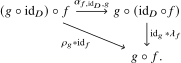
• For an identification \(\alpha \colon f = f'\) of functors \(C \to D\) there are commutative squares of identifications

• For identifications \(\alpha\colon f = f'\), \(\beta\colon g = g'\) and \(\gamma \colon h = h'\), the following square of identifications commutes:
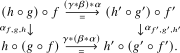
These comparisons are identifications of the corresponding functors on products of the input animae of identifications. Their restrictions along functors into those animae give the same formulas for identifications.
Remark 1.2.1. Taking some of the input identifications to be identities gives compatibility with identifications in each individual functor.
It will sometimes be convenient to abbreviate the conditions from Axiom A.7 as follows:
\[
\id \ast \alpha = \alpha = \alpha \ast \id \qquadtext{ and } (\gamma \ast \beta) \ast \alpha = \gamma \ast (\beta \ast \alpha).
\]
More generally, if we are given identifications \(\alpha\colon f = g\) and \(\alpha' \colon f' = g'\) of functors \(C \to D\), and we happen to be given identifications \(f = f'\) and \(g = g'\), we will write \(\alpha = \alpha'\) to indicate the existence of a commutative square of identifications as follows:

1.2.4 The pentagon and triangle identities
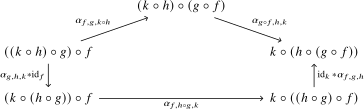
Finally, the unitors and associator must themselves be compatible. The pentagon compares the two ways of reassociating a composite of four functors. The triangle compares removing an identity functor before or after reassociation.
Axiom A.8 (Pentagon and triangle identities). For functors \(f\colon A \to B\), \(g\colon B \to C\), \(h\colon C \to D\) and \(k\colon D \to E\), the following pentagon of identifications commutes:
 Moreover, for composable functors \(f\colon C\to D\) and \(g\colon D\to E\), the
following triangle of identifications commutes: