Remark 4.2. Since \(y(x)\) is compact in \(\Ind (C)\), maps \(y(x) \to \quotcolim _i z_i\) are the same as maps \(x \to z_i\) for some \(i\), up to the usual
identifications. Hence \(f\) is weakly compact if and only if for every \(Z \in \Ind (C)\), every diagram of solid arrows 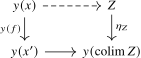 admits a dashed arrow making the square commute. Here \(\eta _Z\) is the unit of the adjunction \(\colim \dashv y\) of Construction A.21, and a
map \(y(x') \to y(\colim Z)\) is the same as a map \(x' \to \colim Z\), since \(y\) is fully faithful.
A compact morphism in the sense of Definition 3.3 is weakly compact: the factorization of \(f^*\) through \(\Map _{\Ind (C)}(y(x),-)\) provides, in particular, a lift of each point. In the terminology of [Krause et al. (2024), Definition 2.2.4], compact morphisms in our sense are called strongly compact.