Proposition 14.2.4. The construction \(\Oo \mapsto (\Oo ^{\otimes },p_{\Oo })\) defines a functor from classical colored operads to \(\infty \)-operads. The underlying \(\infty \)-category of the associated \(\infty \)-operad is naturally equivalent to the classical category \(U(\Oo )\) of colors and unary operations. For a span \(\alpha =(I\xleftarrow {f}K\xrightarrow {g}J)\) and families of colors \(\{x_i\}_{i\in I}\) and \(\{y_j\}_{j\in J}\), there is an isomorphism \[ \Hom _{\Oo ^{\otimes }}^{\alpha } (\{x_i\}_{i\in I},\{y_j\}_{j\in J}) \quad \simeq \quad \prod _{j\in J}\Oo (\{x_{f(k)}\}_{k\in g^{-1}(j)};y_j). \] In particular, its multimorphism animae are the classical operation sets, regarded as discrete animae.
Proof. By Lemma 14.2.2, the map \[ \Hom _{\Oo ^{\otimes }}(\{x_i\}_{i \in I}, \{y_j\}_{j \in J}) \to \Hom _{\Span (\Fin )}(I,J) \] on hom animae forgets the operation labels on a span. Its fiber over \(\alpha \) is the displayed product of operation sets, since there is a unique way to transport labels along a bijection of spans.
We show that concatenation gives binary products in \(\Oo ^{\otimes }\), with projections given by the backwards spans for the summand inclusions labeled by the identity. To see this, consider tuples \(\{x_i\}_{i \in I}\), \(\{y_j\}_{j \in J}\) and \(\{z_k\}_{k \in K}\). The projections give a commutative square

in which the bottom map is an isomorphism because disjoint union is the product in \(\Span (\Fin )\). From the computation of the first paragraph, it is also clear that the induced map on fibers is a bijection showing that \(\{y_j\}\sqcup \{z_k\}\) is a product in \(\Oo ^{\otimes }\) of \(\{y_j\}\) and \(\{z_k\}\). In analogous fashion one shows that the empty tuple is the terminal object, so that \(\Oo ^{\otimes }\) admits finite products. It is also clear from these computations that \(p_{\Oo }\) preserves finite products.
Next we identify fiber \(\Oo ^{\otimes }_I\) over a finite set \(I\) with the product \(U(\Oo )^I\). There is a map of simplicial animae \(N(U(\Oo )^I) \to N_{\mathrm {span}}(\Oo )\) given in degree \(n\) by sending a string of \(n\) composable morphisms in \(U(\Oo )^I\) to the constant pullback diagram \(\const _I \colon \Tw ^r([n]) \to \Fin \) labeled by the composites of the given unary operations. Since the underlying pullback diagram is constant on \(I\), passing to associated \(\infty \)-categories results in a functor \[ U(\Oo )^I\longrightarrow \Oo ^{\otimes }_I. \] This functor is clearly essentially surjective, and it is fully faithful by the earlier identification of the hom animae for \(\alpha = \id _I\). We conclude it is an equivalence.
For \(I=\lra {1}\) this identifies the underlying category as claimed. Under these equivalences, concatenation is the equivalence required in condition (2) of Definition 14.1.1.
Next we verify the full cocartesian universal property. Let \(u\colon K\to I\) be a map in \(\Fin \), let \(\{x_i\}_{i\in I}\) be a family of colors, and let \(\widehat b\colon \{x_i\}_{i\in I}\to \{x_{u(k)}\}_{k\in K}\) be the lift of \(b=(I\xleftarrow {u}K\xrightarrow {=}K)\) whose labels are identities. For any tuple \(Y=\{y_j\}_{j\in J}\), consider the square
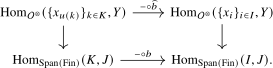
For a span \(\beta =(K\xleftarrow {a}L\xrightarrow {h}J)\), the induced map from the fiber over \(\beta \) to the fiber over \(\beta \circ b\) is identified with the identity on \[ \prod _{j\in J}\Oo (\{x_{u(a(l))}\}_{l\in h^{-1}(j)};y_j), \] since composition with \(\widehat b\) leaves the operation labels unchanged by the unit axiom. Thus the square is a pullback, showing that \(\widehat b\) is \(p_{\Oo }\)-cocartesian.
Finally, let \(f\colon B\to A\) and let \(X_a\) be arbitrary objects of \(\Oo ^{\otimes }\), represented by tuples indexed by \(T_a\). The map in condition (3) of Definition 14.1.1 is the identity-labeled backwards span associated with \[ \bigsqcup _{b\in B}T_{f(b)}\longrightarrow \bigsqcup _{a\in A}T_a,\qquad (b,t)\longmapsto (f(b),t). \] The preceding argument proves it cocartesian.
The functor induced by a morphism of classical operads preserves concatenation, its projections, and the empty tuple, hence finite products. □