We begin by recalling the three conditions obtained in Chapter 12, now using the span category constructed in Chapter 13. We then define morphisms of \(\infty \)-operads and the \(\infty \)-category they form.
Definition 14.1.1. An \(\infty \)-operad (or: \(\Span (\Fin )\)-\(\infty \)-operad) is a pair \(\Oo = (\Oo ^{\otimes },p_{\Oo })\) consisting of an \(\infty \)-category \(\Oo ^{\otimes }\) equipped with a functor \(p_{\Oo }\colon \Oo ^{\otimes } \to \Span (\Fin )\) satisfying the following conditions:
- (1)
-
The \(\infty \)-category \(\Oo ^{\otimes }\) admits finite products, and the functor \(p_{\Oo }\) preserves finite products;
- (2)
-
For every finite set \(I\), the product in \(\Oo ^{\otimes }\) defines an equivalence \[ \prod _{i \in I} \Oo ^{\otimes }_{\{i\}} \iso \Oo ^{\otimes }_I, \] where \(\Oo ^{\otimes }_I\) denotes the fiber of \(p_{\Oo }\) over the set \(I\);
- (3)
-
For a morphism \(f\colon J \to I\) in \(\Fin \) and objects \(X_i \in \Oo ^{\otimes }\), the map \(\widetilde {f}\colon \prod _{i\in I} X_i \to \prod _{j \in J} X_{f(j)}\) whose \(j\)-th component is the projection to \(X_{f(j)}\) is \(p_{\Oo }\)-cocartesian.
Here cocartesian morphisms are understood in the sense of Definition 24.1.1. The objects \(X_i\) in condition (3) are not required to be colors; this more general form will be used in Proposition 14.1.12.
If \(\Pp = (\Pp ^{\otimes }, p_{\Pp })\) is another \(\infty \)-operad, then a morphism of \(\infty \)-operads \(f\colon \Oo \to \Pp \) is a commutative diagram
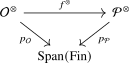
such that the functor \(f^{\otimes }\) preserves finite products.
If we write \(\Cat ^{\mathrm {prod}}_{\infty }\) for the (very large) \(\infty \)-category of \(\infty \)-categories that admit finite products and functors that preserve finite products, we obtain a full subcategory \[ \Op _{\infty } \quad \subseteq \quad (\Cat ^{\mathrm {prod}}_{\infty })_{/\Span (\Fin )} \] spanned by the \(\infty \)-operads. Given two \(\infty \)-operads \(\Oo \) and \(\Pp \), we will denote by \(\Fun _{\Op _{\infty }}(\Oo ,\Pp )\) the \(\infty \)-category of morphisms of \(\infty \)-operads from \(\Oo \) to \(\Pp \), defined as the following fiber:
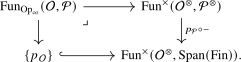
In certain contexts, morphisms of \(\infty \)-operads \(\Oo \to \Pp \) are also known as \(\Oo \)-algebras in \(\Pp \), and a common alternative notation for the \(\infty \)-category \(\Fun _{\Op _{\infty }}(\Oo ,\Pp )\) is \(\Alg _{\Oo }(\Pp )\).
Example 14.1.2. The commutative \(\infty \)-operad \(\Comm \) is given by \(\Comm ^{\otimes } = \Span (\Fin )\) and \(p_{\Comm } = \id \colon \Span (\Fin ) \to \Span (\Fin )\). This is the terminal \(\infty \)-operad.
Example 14.1.3. The \(\infty \)-operad \(\Ee _0\) of pointed objects is given by \[ \Ee _0^{\otimes } := \Span (\Fin ,\all ,\inj ) \qquadtext { and } p_{\Ee _0} = \incl \colon \Span (\Fin ,\all ,\inj ) \hookrightarrow \Span (\Fin ). \] The finite-product conditions in the definition of an \(\infty \)-operad follow from part (1) of Lemma 13.3.8; the fibers of \(p_{\Ee _0}\) are contractible, and the backwards spans remain cocartesian under the inclusion into \(\Span (\Fin )\).
Observation 14.1.4. The \(\infty \)-category \(\Op _{\infty }\) admits finite products. The terminal object is \(\Comm \), and the product of \(\infty \)-operads \(\Oo \) and \(\Pp \) has total category \[ (\Oo \times \Pp )^{\otimes } = \Oo ^{\otimes }\times _{\Span (\Fin )}\Pp ^{\otimes }. \] Indeed, finite products, the decomposition of the fibers, and the required cocartesian lifts are all computed componentwise in this fiber product.
Warning 14.1.5. As mentioned in Remark 12.4.3, our definition of \(\infty \)-operads does not agree with the standard one in the literature, due to Lurie, which we will discuss in Section 19.4 below. However, the difference is mostly inconsequential for practical purposes, as most constructions with Lurie’s definition go through with our definition. The main difference is that with our definition we can state various conditions on the \(\infty \)-category \(\Oo ^{\otimes }\) in terms of finite products rather than via a Segal condition.
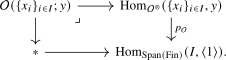
Terminology 14.1.6. We write \(U(\Oo ) := \Oo ^{\otimes }_{\lra {1}}\) for the underlying \(\infty \)-category of \(\Oo \), where \(\lra {1} := \{1\}\). Its objects are the colors of \(\Oo \), and its morphisms are the unary operations. Restriction to this fiber defines a functor \(U\colon \Op _{\infty }\to \Cat _{\infty }\). We denote the groupoid core of \(U(\Oo )\) by \[ \Oo ^{\simeq } \quad := \quad U(\Oo )^{\simeq } \] and refer to it as the anima of colors of \(\Oo \). Unlike the classical set of colors, this anima also remembers the invertible unary morphisms between them. For a finite set \(I\), condition (2) guarantees that every object in \(\Oo ^{\otimes }_I\) may be uniquely written as a product \(\prod _{i \in I} x_i\) for some colors \(x_i \in \Oo ^{\simeq }\). In analogy with the classical case, we may also denote such a product as an unordered tuple \(\{x_i\}_{i \in I}\). Given another color \(y \in \Oo ^{\simeq }\), we define the anima of multimorphisms in \(\Oo \) from \(\{x_i\}_{i \in I}\) to \(y\) as the anima of morphisms in \(\Oo ^{\otimes }\) that map to the span \(I \xleftarrow {=} I \to \lra {1}\):
A morphism \(\phi \colon X \to Y\) in \(\Oo ^{\otimes }\) whose image in \(\Span (\Fin )\) is a forward map \(I \xleftarrow {=} I \xrightarrow {g} J\) is called an active morphism. We say \(\phi \) is an inert morphism if it is \(p_{\Oo }\)-cocartesian and its image in \(\Span (\Fin )\) is a backwards map \(I \xleftarrow {f} J \xrightarrow {=} J\). We want to think of the active morphisms as the ones that encode the operad structure, and of the inert morphisms as merely capturing the product structure in \(\Oo ^{\otimes }\).
14.1.1 Suboperads and fully faithful morphisms
Construction 14.1.7 (Suboperads). Let \(\Oo \) be an \(\infty \)-operad, and choose a subanima \(\Pp ^{\simeq }\subseteq \Oo ^{\simeq }\) of colors. For each tuple of chosen colors \(\{x_i\}_{i\in I}\) and chosen color \(y\), choose a subanima \[ \Pp (\{x_i\}_{i\in I};y)\subseteq \Oo (\{x_i\}_{i\in I};y). \] Assume that these choices are invariant under bijections of the input sets and isomorphisms of the chosen colors, contain the identity operations, and are closed under substitution of multimorphisms.
These data define a suboperad \(\Pp \subseteq \Oo \). Its total category has the tuples of chosen colors as objects. A morphism \(\{x_i\}_{i\in I}\to \{y_j\}_{j\in J}\) over a span \(I\xleftarrow {u}K\xrightarrow {v}J\) belongs to \(\Pp ^{\otimes }\) if each of its component operations belongs to \[ \Pp (\{x_{u(k)}\}_{k\in v^{-1}(j)};y_j), \qquad j\in J. \] Here the component operation is obtained by projecting to \(y_j\) and factoring through the cocartesian reindexing map to \(\{x_{u(k)}\}_{k\in v^{-1}(j)}\). The component operations of a composite are substitutions of those of its factors. Thus the specified morphisms are closed under identities and composition, resulting in a subcategory \(\Pp ^{\otimes }\subseteq \Oo ^{\otimes }\).
We now check the three conditions of Definition 14.1.1. Products are given by concatenation of tuples: the product projections have identity component operations, and a morphism into a concatenation belongs to \(\Pp ^{\otimes }\) precisely when all its projections do. The projection to \(\Span (\Fin )\) therefore preserves finite products. Over an identity span, the component operations are unary, giving the required equivalence \(\Pp ^{\otimes }_I\simeq U(\Pp )^I\). Finally, the reindexing maps belong to \(\Pp ^{\otimes }\), since their component operations are identities. The ambient cocartesian isomorphisms identify morphisms with the same component operations, so they restrict to \(\Pp ^{\otimes }\). This proves condition (3) for colors; decomposing each \(X_i\) into colors gives the general case. Hence \(\Pp \) is an \(\infty \)-operad, and its inclusion preserves finite products.
If we choose all multimorphisms between the chosen colors, then \(\Pp ^{\otimes }\) is the full subcategory of \(\Oo ^{\otimes }\) on their tuples. We call \(\Pp \) the full suboperad of \(\Oo \) spanned by \(\Pp ^{\simeq }\).
Definition 14.1.8. A morphism of \(\infty \)-operads \(f\colon \Oo \to \Pp \) is called fully faithful if for every finite set \(I\) and every collection of colors \(\{x_i\}_{i \in I}\) and \(y\) of \(\Oo \), the induced map \[ \Oo (\{x_i\}_{i \in I}; y) \to \Pp (\{f(x_i)\}_{i \in I}; f(y)) \] is an equivalence of animae.
The inclusion of a full suboperad is fully faithful. To relate this condition to full faithfulness of the functor on total categories, we describe morphisms in \(\Oo ^{\otimes }\) in terms of multimorphisms.
Notation 14.1.9. Given a functor \(p_{\Oo }\colon \Oo ^{\otimes } \to \Span (\Fin )\) and a morphism \(\alpha \colon I \to J\) in \(\Span (\Fin )\), we write \[ \Hom _{\Oo ^{\otimes }}^{\alpha }(X,Y) \qquad := \qquad \fib _{\alpha }(\, p_{\Oo }\colon \Hom _{\Oo ^{\otimes }}(X,Y) \to \Hom _{\Span (\Fin )}(I,J) \, ) \] for all \(X,Y \in \Oo ^{\otimes }\) with \(p_{\Oo }(X) \cong I\) and \(p_{\Oo }(Y) \cong J\).
Lemma 14.1.10. Let \(\Oo \) be an \(\infty \)-operad and \(\alpha =(I\xleftarrow {u}K\xrightarrow {v}J)\) a span of finite sets. Taking products of multimorphisms and precomposing with the inert map \(\{x_i\}_{i\in I}\to \{x_{u(k)}\}_{k\in K}\) gives an isomorphism of animae \[ \prod _{j\in J}\Oo (\{x_{u(k)}\}_{k\in v^{-1}(j)};y_j) \iso \Hom ^{\alpha }_{\Oo ^{\otimes }}(\{x_i\}_{i\in I},\{y_j\}_{j\in J}), \] natural in \(\Oo \), for all families of colors \(\{x_i\}_{i\in I}\) and \(\{y_j\}_{j\in J}\).
Proof. Factor \(\alpha \) as the backwards span \(I\xleftarrow {u}K\xrightarrow {=}K\) followed by the active span \(\gamma =(K\xleftarrow {=}K\xrightarrow {v}J)\). By condition (3) of Definition 14.1.1 and preservation of products by \(p_{\Oo }\), we obtain \begin {align*} \Hom ^{\alpha }_{\Oo ^{\otimes }}(\{x_i\}_{i\in I},\{y_j\}_{j\in J}) &\simeq \Hom ^{\gamma }_{\Oo ^{\otimes }}(\{x_{u(k)}\}_{k\in K},\{y_j\}_{j\in J}) \\ &\simeq \prod _{j\in J}\Hom ^{\rho _j\circ \gamma }_{\Oo ^{\otimes }}(\{x_{u(k)}\}_{k\in K},y_j) \\ &\simeq \prod _{j\in J}\Oo (\{x_{u(k)}\}_{k\in v^{-1}(j)};y_j), \end {align*}
where \(\rho _j\colon J\to \{j\}\) is the product projection in \(\Span (\Fin )\). The last isomorphism uses condition (3) again, applied to \(v^{-1}(j)\hookrightarrow K\). The inverse of this composite is the map in the statement. Naturality follows because morphisms of \(\infty \)-operads preserve products and their projections. □
It follows that a morphism of \(\infty \)-operads \(f\colon \Oo \to \Pp \) is fully faithful if and only if \(f^{\otimes }\) is fully faithful. Indeed, the maps on hom animae of the total categories lie over the same hom anima in \(\Span (\Fin )\), and Lemma 14.1.10 identifies their maps on fibers with products of the maps on multimorphism animae. Conversely, full faithfulness of \(f^{\otimes }\) implies full faithfulness on multimorphisms by taking fibers over active spans with singleton target.
Lemma 14.1.11. Let \(f\colon \Oo \to \Pp \) be a morphism of \(\infty \)-operads. If \(f\) is fully faithful and the induced functor \(U(\Oo ) \to U(\Pp )\) is essentially surjective, then \(f\) is an equivalence of \(\infty \)-operads.
Proof. By the preceding observation, \(f^{\otimes }\) is fully faithful. Every object of \(\Pp ^{\otimes }\) is a finite product of colors, each of which is in the image of \(f\) by assumption. Since \(f^{\otimes }\) preserves finite products, it is essentially surjective as well. Thus \(f^{\otimes }\) is an equivalence over \(\Span (\Fin )\), and hence \(f\) is an equivalence of \(\infty \)-operads. □
14.1.2 An alternative characterization of \(\infty \)-operads
To recognize an \(\infty \)-operad, it is often easier to construct cocartesian lifts than to establish the finite-product conditions directly. The following characterization allows us to do this.
Proposition 14.1.12. Consider a functor \(p_{\Oo }\colon \Oo ^{\otimes } \to \Span (\Fin )\). Then \((\Oo ^{\otimes }, p_{\Oo })\) is an \(\infty \)-operad if and only if the following conditions are satisfied:
- (i)
-
\(\Oo ^{\otimes }\) admits all \(p_{\Oo }\)-cocartesian lifts of backwards morphisms \(I \xleftarrow {f} J \xrightarrow {=} J\) in \(\Span (\Fin )\);
- (ii)
-
For every finite set \(I\), the functor \[ \Oo ^{\otimes }_I \to \prod _{i \in I} \Oo ^{\otimes }_{\{i\}} \] given by cocartesian transport along the maps \(\rho _i\colon I \hookleftarrow \{i\} \xrightarrow {=} \{i\}\) in \(\Span (\Fin )\) is an equivalence, where the transport functors are supplied by Proposition 24.1.4;
- (iii)
-
Consider an object \(Y \in \Oo ^{\otimes }\) with image \(J := p_{\Oo }(Y) \in \Span (\Fin )\) and cocartesian lifts \(Y \to Y_j\) over the maps \(\rho _j\) in \(\Span (\Fin )\). Then the maps \(Y \to Y_j\) exhibit \(Y\) as a product \(\prod _{j \in J} Y_j\) in \(\Oo ^{\otimes }\).
Proof. First suppose that \(\Oo \) is an \(\infty \)-operad. Every object is a product of colors, and condition (3) of Definition 14.1.1 says that reindexing such a product gives a cocartesian lift of the corresponding backwards span. This proves (i). In particular, the product projections are cocartesian lifts of the \(\rho _i\). Thus cocartesian transport along the \(\rho _i\) is inverse to the product functor, proving (ii), and uniqueness of cocartesian lifts gives (iii).
Conversely, assume (i)–(iii). By (ii), any family of colors \(\{x_i\}_{i\in I}\) is obtained by cocartesian transport from an object over \(I\). By (iii), the resulting maps exhibit this object as \(\prod _{i\in I}x_i\). Thus the inverse of the equivalence in (ii) is the product functor, giving condition (2) of the definition.
For arbitrary objects \(Y^1,\dots ,Y^n\), write \(T_i:=p_{\Oo }(Y^i)\) and decompose each \(Y^i\) into its color factors \(Y^i_t\). Assembling all these colors gives an object \(Y\) over \(\coprod _iT_i\) which, by associativity of products, is a product of the \(Y^i\). Cocartesian transport of \(Y\) along the backwards inclusion \(\coprod _iT_i\hookleftarrow T_i\) has the same color factors as \(Y^i\), since cocartesian morphisms compose. By (ii), its target identifies with \(Y^i\), and by (iii) the resulting map \(Y\to Y^i\) is the product projection. Its image under \(p_{\Oo }\) is therefore the corresponding product projection in \(\Span (\Fin )\). This proves that finite products exist and are preserved by \(p_{\Oo }\), giving condition (1).
For condition (3), first consider colors \(x_i\) and a map \(f\colon J\to I\). Choose a cocartesian lift \(\prod _{i\in I}x_i\to Y\) of the backwards span associated with \(f\), followed by cocartesian lifts \(Y\to Y_j\) of the projections \(\rho _j\). Their composites lift the projections selecting \(x_{f(j)}\), so uniqueness of cocartesian lifts identifies them with the product projections \(\prod _{i\in I}x_i\to x_{f(j)}\). By (iii), the maps \(Y\to Y_j\) exhibit \(Y\) as \(\prod _{j\in J}x_{f(j)}\). Hence the projection-induced reindexing map is cocartesian. For arbitrary \(X_i\), write \(X_i\simeq \prod _{t\in T_i}x_{i,t}\) with \(T_i=p_{\Oo }(X_i)\) and apply the case of colors to \[ \coprod _{j\in J}T_{f(j)}\longrightarrow \coprod _{i\in I}T_i, \qquad (j,t)\longmapsto (f(j),t). \] Under the product decompositions, this gives precisely the required map \(\prod _{i\in I}X_i\to \prod _{j\in J}X_{f(j)}\). □
It is sometimes convenient to use the notation from Notation 14.1.9 to give the following alternative formulation of part (iii).
Lemma 14.1.13. Given a functor \(p_{\Oo }\colon \Oo ^{\otimes } \to \Span (\Fin )\) and cocartesian morphisms \(Y \to Y_j\) over the maps \(\rho _j\), these maps exhibit \(Y\) as a product of the \(Y_j\) in \(\Oo ^{\otimes }\) if and only if for every \(X \in \Oo ^{\otimes }_I\) and every \(\alpha \in \Hom _{\Span (\Fin )}(I,J)\) they induce an equivalence \[ \Hom _{\Oo ^{\otimes }}^{\alpha }(X,Y) \to \prod _{j \in J} \Hom _{\Oo ^{\otimes }}^{\rho _j \circ \alpha }(X,Y_j). \]
Proof. The maps \(Y \to Y_j\) exhibit \(Y\) as a product if and only if for every \(X \in \Oo ^{\otimes }_I\) the top map in the following square is an equivalence:
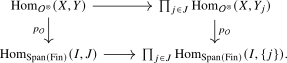
Since the bottom map is an equivalence, this is equivalent to the square being a pullback square, which is in turn equivalent to the condition that the top map induces isomorphisms on all fibers over \(\alpha \in \Hom _{\Span (\Fin )}(I,J)\). □
Corollary 14.1.14. If \(\Oo \) is an \(\infty \)-operad, then the inert morphisms in \(\Oo ^{\otimes }\) are precisely the morphisms of the form \(\widetilde {f}\colon \prod _{i \in I} x_i \to \prod _{j \in J} x_{f(j)}\) for maps \(f\colon J \to I\) in \(\Fin \) and colors \(x_i \in \Oo ^{\simeq }\).
Similarly, if \(\Pp \) is another \(\infty \)-operad, and \(\phi ^{\otimes }\colon \Oo ^{\otimes } \to \Pp ^{\otimes }\) is a functor over \(\Span (\Fin )\), then \(\phi ^{\otimes }\) preserves finite products (i.e., corresponds to a morphism \(\phi \colon \Oo \to \Pp \) of \(\infty \)-operads) if and only if it preserves the inert morphisms.
Proof. By assumption \(\widetilde {f}\) is inert for every \(f\). Conversely, we saw in the proof of Proposition 14.1.12 that for every backwards span \(I \xleftarrow {\smash {f}} J \xrightarrow {=} J\) and every \(X \in \Oo ^{\otimes }_I\) the map \(\widetilde {f} \colon X \simeq \prod _{i \in I} X_i \to \prod _{j \in J} X_{f(j)}\) is a cocartesian lift of \(f\) starting in \(X\), so by uniqueness it follows that every cocartesian lift is of this form.
If \(\phi ^{\otimes }\) preserves finite products, it in particular preserves the maps \(\widetilde {f}\colon \prod _{i \in I} X_i \to \prod _{j \in J} X_{f(j)}\), hence all inert morphisms. Conversely, if \(\phi ^{\otimes }\) preserves inert morphisms, it sends the projections from a tuple of colors to cocartesian lifts of the same spans \(\rho _j\). By condition (iii) of Proposition 14.1.12, these exhibit the image of the tuple as the product of the images of its colors. Since finite products are given by concatenation of tuples, \(\phi ^{\otimes }\) preserves them. □
Remark 14.1.15. Let \(\Oo = (\Oo ^{\otimes },p_{\Oo })\) be an \(\infty \)-operad. Then every morphism \(\phi \colon X \to Z\) in \(\Oo ^{\otimes }\) factors uniquely as \[ X \xrightarrow {\widetilde {f}} Y \xrightarrow {\psi } Z, \] where \(\widetilde {f}\) is an inert morphism and \(\psi \) is an active morphism. To see this, let us denote by \(I \xleftarrow {f} K \xrightarrow {g} J\) the image of \(\phi \) under \(p\). This span may be factored uniquely as a composite of a backwards span \(I \xleftarrow {f} K \xrightarrow {=} K\) followed by a forward span \(K \xleftarrow {=} K \xrightarrow {g} J\). We then let \(\widetilde {f}\colon X \to Y\) be the unique cocartesian lift of \(f\) with domain \(X\). It follows that there is a unique morphism \(\psi \colon Y \to Z\) over \(g\) such that \(\psi \circ \widetilde {f} = \phi \).
The argument above produces a factorization and shows that any two of them are isomorphic. With more care, it in fact shows that the factorization is unique, in the sense that the anima of factorizations of \(\phi \) is contractible. We will deduce this in Section 19.1 from the general theory of factorization systems on an \(\infty \)-category, where we show that the inert and active morphisms define such a system on \(\Oo ^{\otimes }\).