The simplest \(\infty \)-operads are those without any operations beyond the unary ones, generalizing the trivial colored operads of Example 12.2.6. Given an \(\infty \)-category \(C\), we will construct an \(\infty \)-operad \(\Triv _C\) with underlying \(\infty \)-category \(C\) and multimorphism animae \[ \Triv _C(\{x_i\}_{i \in I};y) \quad \simeq \quad \begin {cases} \Hom _C(x_{i_0},y) & \text {if } I = \{i_0\} \text { is a singleton;} \\ \emptyset & \text {otherwise,} \end {cases} \] with composition given by composition in \(C\). There is no operadic structure left to specify: operations of arity \(\neq 1\) do not exist, and the unary operations are simply the morphisms of \(C\). To construct \(\Triv _C\), note that multimorphisms from \(\{x_i\}_{i \in I}\) to \(y\) live over the active span \(I \xleftarrow {=} I \to \lra {1}\), which lies in the subcategory \(\Fin \catop \subseteq \Span (\Fin )\) precisely when \(I\) is a singleton. We should therefore look for an \(\infty \)-operad whose structure map factors through the inclusion \(\Fin \catop \hookrightarrow \Span (\Fin )\).
The construction is based on the following \(\infty \)-category of finite families, which will reappear in Section 15.2 as the basis for cocartesian monoidal structures.
Construction 14.3.1 (Finite families). Let \(C\) be an \(\infty \)-category. There is a unique finite-product-preserving functor \[ C^{(-)}\colon \Fin \catop \to \Cat _{\infty } \] which sends the one-point set to \(C\); explicitly, it sends a finite set \(I\) to the \(\infty \)-category \(C^I\) of \(I\)-indexed families and a map \(f\colon I \to J\) to the restriction functor \(f^*\colon C^J \to C^I\). Equivalently, this functor is the right Kan extension of \(C\) from the one-point set. We write \[ q\colon \Fin (C) \to \Fin \] for its cartesian unstraightening. Thus objects of \(\Fin (C)\) are finite unordered tuples \(\{x_i\}_{i \in I}\), while morphisms \(\{x_i\}_{i \in I} \to \{y_j\}_{j \in J}\) are pairs \((f,(\phi _i)_{i \in I})\) consisting of a map \(f\colon I \to J\) and morphisms \(\phi _i\colon x_i \to y_{f(i)}\) in \(C\) for all \(i \in I\).
We record the following basic observations about the \(\infty \)-category of finite families:
- The fiber of \(q\) over \(\lra {1}\) is equivalent to \(C\), and the resulting inclusion \(i\colon C \hookrightarrow \Fin (C)\) is fully faithful.
- A morphism \((f,(\phi _i)_{i \in I})\colon \{x_i\}_{i \in I} \to \{y_j\}_{j \in J}\) is \(q\)-cartesian if and only if each \(\phi _i\) is an isomorphism in \(C\). We denote by \[ \Fin (C)_{\ct } \subseteq \Fin (C) \] the wide subcategory spanned by the \(q\)-cartesian morphisms.
- The \(\infty \)-category \(\Fin (C)\) admits finite coproducts, given by concatenation of unordered tuples, and the functor \(q\colon \Fin (C) \to \Fin \) preserves finite coproducts. More precisely, given a finite collection of objects \(X_a \in \Fin (C)\) for \(a \in A\), we may uniquely write each \(X_a\) as \(\{x^a_j\}_{j \in J_a}\) for some finite set \(J_a\), and then the coproduct is given by \(X = \{x^a_j\}_{(a,j) \in \bigsqcup _{a \in A} J_a}\), with the maps \(X_a \to X\) given by the \(q\)-cartesian morphisms over the inclusions \(J_a \hookrightarrow \bigsqcup _{a \in A} J_a\). This follows from Proposition 24.2.10.
Together with the fully faithful inclusion \(i\), these coproducts exhibit \(\Fin (C)\) as the free finite-coproduct completion of \(C\):
Lemma 14.3.2. Let \(C\) be an \(\infty \)-category. For every \(\infty \)-category \(D\) with finite coproducts, restriction along the fully faithful inclusion \(i\colon C \hookrightarrow \Fin (C)\) induces an equivalence \[ i^*\colon \Fun ^{\amalg }(\Fin (C),D) \iso \Fun (C,D), \] where \(\Fun ^{\amalg }(-,-)\) denotes the full subcategory of functors preserving finite coproducts.
Proof. For a finite family \(\{x_k\}_{k\in K}\), its relative slice under \(i\) is \[ C\times _{\Fin (C)}\Fin (C)_{/\{x_k\}_{k\in K}} \simeq \coprod _{k\in K}C_{/x_k}. \] Each \(C_{/x_k}\) has terminal object \(\id _{x_k}\). Thus every functor \(F\colon C\to D\) admits a left Kan extension along \(i\), given by \[ (i_!F)(\{x_k\}_{k\in K})\simeq \coprod _{k\in K}F(x_k). \] This formula shows that \(i_!F\) preserves finite coproducts. The unit of \(i_!\dashv i^*\) is an isomorphism because \(i\) is fully faithful. For a finite-coproduct-preserving functor \(G\), the counit is the canonical isomorphism \(\coprod _{k\in K}G(x_k)\iso G(\{x_k\}_{k\in K})\). Hence \(i_!\) and \(i^*\) are inverse equivalences. □
Construction 14.3.3 (Trivial operads). Let \(C\) be an \(\infty \)-category. Applying Construction 14.3.1 to \(C\catop \) gives a cartesian fibration \(q\colon \Fin (C\catop ) \to \Fin \); passing to opposite categories, we obtain a functor \(q\catop \colon \Fin (C\catop )\catop \to \Fin \catop \). We define \[ \Triv _{C}^{\otimes } := \Fin (C\catop )\catop , \qquad \qquad p_{\Triv _C}\colon \Fin (C\catop )\catop \xrightarrow {q\catop } \Fin \catop \hookrightarrow \Span (\Fin ), \] and refer to \(\Triv _C\) as the trivial operad generated by \(C\). Unwinding Construction 14.3.1, the objects of \(\Triv _C^{\otimes }\) are finite unordered tuples \(\{x_i\}_{i \in I}\) of objects of \(C\), while a morphism \(\{x_i\}_{i \in I} \to \{y_j\}_{j \in J}\) lying over the backwards span \(I \xleftarrow {g} J \xrightarrow {=} J\) is a collection of morphisms \(x_{g(j)} \to y_j\) in \(C\). The opposite in the definition ensures that the underlying \(\infty \)-category is \(C\) itself, and not \(C\catop \).
Remark 14.3.4. Equivalently, \(q\catop \colon \Triv _C^{\otimes } \to \Fin \catop \) is the cocartesian unstraightening of the functor \(C^{(-)}\) from Construction 14.3.1: it is a cocartesian fibration and its cocartesian straightening \(\Fin \catop \to \Cat _{\infty }\) preserves finite products and sends the point to \(C\).
Lemma 14.3.5. Let \(C\) be an \(\infty \)-category. Then \(\Triv _C\) is an \(\infty \)-operad with underlying \(\infty \)-category \(U(\Triv _C) \simeq C\), and its multimorphism animae are the ones described at the beginning of this section. Moreover, for every \(\infty \)-operad \(\Oo \), restriction to the underlying \(\infty \)-categories induces an equivalence \[ \Fun _{\Op _{\infty }}(\Triv _C,\Oo ) \iso \Fun (C,U(\Oo )). \]
Proof. Let us first check that \(\Triv _C\) is an \(\infty \)-operad. By Construction 14.3.1, the \(\infty \)-category \(\Fin (C\catop )\) admits finite coproducts and \(q\) preserves them, so \(\Triv _C^{\otimes } = \Fin (C\catop )\catop \) admits finite products and \(q\catop \) preserves them; as the inclusion \(\Fin \catop \hookrightarrow \Span (\Fin )\) preserves finite products by part (1) of Lemma 13.3.8, the same is true for \(p_{\Triv _C}\). Since the products of \(\Triv _C^{\otimes }\) are the concatenations of tuples, the fiber over a finite set \(I\) is \(C^I\), whose decomposition \(C^I \simeq \prod _{i \in I}C\) is the one required in the definition of an \(\infty \)-operad.
For the final condition, consider objects \(X_i = \{x^i_a\}_{a \in A_i}\) of \(\Triv _C^{\otimes }\) for \(i \in I\) and a map \(f\colon J \to I\) of finite sets. Read in \(\Fin (C\catop )\), the morphism \(\widetilde {f}\colon \prod _{i \in I}X_i \to \prod _{j \in J}X_{f(j)}\) is the map \(\coprod _{j \in J}X_{f(j)} \to \coprod _{i \in I}X_i\) which restricts on the \(j\)-th summand to the inclusion of \(X_{f(j)}\); it lies over the map \(\bigsqcup _{j \in J}A_{f(j)} \to \bigsqcup _{i \in I}A_i\), \((j,a) \mapsto (f(j),a)\), and all of its components in \(C\catop \) are identities. It is therefore \(q\)-cartesian, and hence \(\widetilde {f}\) is \(q\catop \)-cocartesian. It remains \(p_{\Triv _C}\)-cocartesian after composing with the inclusion \(\Fin \catop \hookrightarrow \Span (\Fin )\): every morphism of \(\Triv _C^{\otimes }\) lies over a backwards span, and composing a non-backwards span with a backwards span is again non-backwards, so the mapping animae over the remaining spans are empty on both sides.
The description of the multimorphism animae follows: the active span \(I \xleftarrow {=} I \to \lra {1}\) lies in \(\Fin \catop \) only when \(I\) is a singleton, in which case it is the identity of \(\lra {1}\). Thus \(\Triv _C(\{x_i\}_{i \in I};y)\) is empty unless \(I = \{i_0\}\), in which case it is the anima of morphisms \(x_{i_0} \to y\) in the fiber \((\Triv _C)^{\otimes }_{\lra {1}} \simeq C\).
We turn to the universal property, which will follow from the universal property of \(\Fin (C\catop )\). Indeed, applying Lemma 14.3.2 to \(C\catop \) and passing to opposite categories, we see that restriction along the inclusion \(j\colon C \hookrightarrow \Triv _C^{\otimes }\) of the fiber over \(\lra {1}\) induces an equivalence \[ j^*\colon \Fun ^{\times }(\Triv _C^{\otimes },E) \iso \Fun (C,E) \] for every \(\infty \)-category \(E\) that admits finite products. This equivalence is natural in \(E\), so applying it to \(E = \Oo ^{\otimes }\) and to \(E = \Span (\Fin )\) yields a commutative square
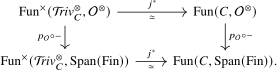
The composite \(p_{\Triv _C} \circ j\) is the constant functor at \(\lra {1}\), so passing to the fibers over \(p_{\Triv _C}\) and \(\const _{\lra {1}}\) gives equivalences \[ \Fun _{\Op _{\infty }}(\Triv _C,\Oo ) \iso \Fun (C,\Oo ^{\otimes })\times _{\Fun (C,\Span (\Fin ))}\{\const _{\lra {1}}\} \simeq \Fun (C,U(\Oo )), \] where the second equivalence holds because \(\Fun (C,-)\) preserves pullbacks. By construction, this equivalence is given by restriction to the underlying \(\infty \)-categories. □
Note that the construction \(C \mapsto \Triv _C\) is functorial in \(C\) and thus defines a functor \(\Triv _{(-)}\colon \Cat _{\infty } \to \Op _{\infty }\). It may be characterized as follows:
Corollary 14.3.6. The functor \(\Triv _{(-)}\colon \Cat _{\infty } \to \Op _{\infty }\) is left adjoint to the functor \[ U\colon \Op _{\infty } \to \Cat _{\infty }, \qquad \Oo \mapsto U(\Oo ), \] and it is fully faithful.
Proof. The equivalence of Lemma 14.3.5 is natural in both variables. Passing to groupoid cores gives the adjunction, whose unit is the isomorphism \(C\iso U(\Triv _C)\). Thus \(\Triv _{(-)}\) is fully faithful. □
Example 14.3.7. Taking \(C = *\) recovers the trivial operad \[ \Triv := \Triv _*, \qquad \Triv ^{\otimes } = \Fin \catop , \qquad p_{\Triv } = \incl \colon \Fin \catop \hookrightarrow \Span (\Fin ). \] Taking \(C = \emptyset \) gives the empty \(\infty \)-operad \(\Triv _{\emptyset }\), with \(\Triv _{\emptyset }^{\otimes } = *\) and \(p_{\Triv _{\emptyset }}\colon * \xhookrightarrow {\lra {0}} \Span (\Fin )\) the inclusion of the empty set \(\lra {0}\). Since \(\Triv _{(-)}\) is a left adjoint by Corollary 14.3.6, it preserves initial objects; as \(\emptyset \) is initial in \(\Cat _{\infty }\), we conclude that \(\Triv _{\emptyset }\) is the initial \(\infty \)-operad.
Lemma 14.3.8. For every \(\infty \)-operad \(\Oo \), there is a canonical equivalence \[ \Triv \times \Oo \simeq \Triv _{U(\Oo )} \] of \(\infty \)-operads.
Proof. Recall that \(\Triv ^{\otimes } = \Fin \catop \) and that \(p_{\Triv }\colon \Fin \catop \hookrightarrow \Span (\Fin )\) is the inclusion. The product operad \(\Triv \times \Oo \) is therefore represented by the pullback
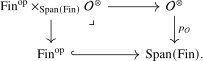
By the defining properties of an \(\infty \)-operad, the left vertical map is a cocartesian fibration whose cocartesian straightening preserves finite products and sends \(\lra {1}\) to \(U(\Oo )\). It is therefore equivalent to \[ \Fin \catop \to \Cat _{\infty }, \qquad I \mapsto U(\Oo )^I. \] By Remark 14.3.4, its cocartesian unstraightening is \[ q_{U(\Oo )}\catop \colon \Fin (U(\Oo )\catop )\catop \to \Fin \catop , \] which is the total category of \(\Triv _{U(\Oo )}\). □
Remark 14.3.9. More generally, restricting an arbitrary \(\infty \)-operad \(\Oo \) to the subcategory \(\Fin \catop \subseteq \Span (\Fin )\) discards precisely the operations of arity \(\neq 1\): by Lemma 14.3.8, the pullback \(\Oo ^{\otimes } \times _{\Span (\Fin )} \Fin \catop \) is the total category of \(\Triv _{U(\Oo )}\). The resulting projection \(\Triv _{U(\Oo )} \to \Oo \) induces the identity on underlying \(\infty \)-categories, and is thus the counit of the adjunction of Corollary 14.3.6.