Proposition 8.8.7. Let \(p\colon C \to S\) be a cocartesian fibration and let \(D\) be a category. Then the functor \[ \pi\colon T := \ulFun_S(C, D \times S) \to S \] is a cartesian fibration whose fiber over an object \(s\) of \(S\) is given by \(\Fun(C_s, D)\).
For any cocartesian functor \(C \to C'\) over \(S\), the induced functor \(\ulFun_S(C',D \times S) \to \ulFun_S(C,D \times S)\) is cartesian over \(S\). Dually, a cartesian fibration \(C\to S\) gives a cocartesian relative functor category, and precomposition along a cartesian functor is cocartesian over \(S\).
Proof
We prove the cocartesian case. The cartesian case is dual, by exchanging the roles of \(0\) and \(1\) in the interval \([1]\).
Recall that for a map \(\alpha\colon S' \to S\), we have a pullback square
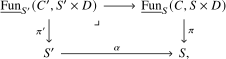 where we write \(C' := S' \times_S C \to S'\). In particular, it follows directly that the fibers of \(\pi\) are given by \(\Fun(C_s,D)\), and it remains to show that \(\pi\) is a cartesian fibration.
We will first show that \(\pi\) is a locally cartesian fibration and then show that locally cartesian morphisms compose. By the dual of Proposition 6.5.4, this will imply the claim.
Consider the following commutative diagram:
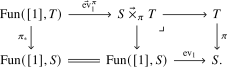 Given a morphism \(u\colon a \to b\) in \(S\), we may consider the fiber of the map \(\vec{\ev}^{\pi}_1\) over \(u \in \Fun([1],S)\) to obtain a functor
\[
l := (\vec{\ev}_1^{\pi})_u \colon \Fun([1],T)_u \to (S \vectimes{\pi} T)_u \simeq T_b.
\]
We claim that \(\pi\) is a locally cartesian fibration if and only if this functor \(l\) admits a right adjoint section \(r\colon T_b \hookrightarrow \Fun([1],T)_u\). Indeed, the existence of \(r\) means that for every object \(t \in T_b\) there exists a morphism \(r(t) \colon t' \to t\) over \(u\) such that for every diagram
 in \(T\) living over \(u\colon a \to b\), there exists a unique dashed arrow filling the square. This is equivalent to \(r(t)\colon t' \to t\) being a locally cartesian lift of \(u\).
This characterization of locally cartesian fibrations works for arbitrary functors \(T \to S\). For our specific \(T\) we must now compute the map \(\Fun([1],T)_u \to T_b\). Its source is \(\Fun(C_u,D)\), where \(C_u\) is defined via the following pullback diagram:
 We also have \(T_b \iso \Fun(C_b, D)\). The map \(\Fun(C_u,D) \to \Fun(C_b, D)\) is given by restriction along the inclusion \(C_b \hookrightarrow C_u\). Our goal now is to find a right adjoint section of this functor.
Recall from Proposition 4.4.4 that if
\(\ell \dashv s\colon A \rightleftarrows B\) and \(s\) is a right adjoint section, then precomposition gives a right adjoint section
\[
s^*\colon \Fun(A,D) \rightleftarrows \Fun(B,D) \noloc \ell^*.
\]
Here \(\ell^*\) is the right adjoint section. Thus it suffices to show that the inclusion \(C_b \hookrightarrow C_u\) is a right adjoint section. This is a general fact about cocartesian fibrations: we have a pullback square
 Since \(p_u\) is a cocartesian fibration and \(\{1\} \hookrightarrow [1]\) admits a left adjoint \([1] \to \{1\}\), Proposition 6.2.4 shows that \(C_b \hookrightarrow C_u\) also admits a left adjoint. Hence the inclusion is a right adjoint section, as desired. This finishes the proof that \(\pi\colon T \to S\) is a locally cartesian fibration.
To see that locally \(\pi\)-cartesian morphisms are closed under composition, we may equivalently show that the locally cartesian transport functors compose. In other words, given two morphisms \(u\colon a \to b\) and \(v\colon b \to c\) in \(S\), we need to show that the composite \[ T_c = \Fun(C_c,D) \xrightarrow{v^*} \Fun(C_b,D) \xrightarrow{u^*} \Fun(C_a,D) = T_a \] agrees with \((vu)^*\colon T_c \to T_a\). To see this, we give an explicit description of \(v^*\) and \(u^*\).
We start by giving an explicit description of the left adjoint \(t\colon C_u \to C_b\) to the inclusion functor \(C_b \to C_u\): on objects, it sends a pair \((t,x)\) consisting of an object \(t\) of \([1]\) and an object \(x\) of \(C_{u(t)}\) to the object \(u(t \to 1)_!(x)\), given by the cocartesian transport of \(x\) along the morphism \(u(t \to 1)\), where \(t \to 1\) is the unique map in \([1]\) from \(t\) to \(1\). The locally cartesian transport \(u^*\colon T_b \to T_a\) along \(u\colon a \to b\) is then given as the following composite: \[ u^*\colon \Fun(C_b, D) \xrightarrow{t^*} \Fun(C_u,D) \xrightarrow{\mathrm{res}} \Fun(C_a,D). \] The first functor sends \(F \colon C_b \to D\) to the assignment \[ (t,x) \mapsto F(u(t \to 1)_!(x)). \] Restricting to \(t = 0\) thus shows that the composite sends \(F\) to the functor \(x \mapsto F(u_!(x))\), which is the precomposition of \(F\) with \(u_!\colon C_a \to C_b\).
Now, given two morphisms \(u\colon a \to b\) and \(v\colon b \to c\) in \(S\), the composite \[ \Fun(C_c,D) \xrightarrow{v^*} \Fun(C_b,D) \xrightarrow{u^*} \Fun(C_a,D) \] is given by precomposition with \(v_! \circ u_!\). Since \(p\) is a cocartesian fibration, this functor is identified with \((v \circ u)_!\colon C_a \to C_c\), so precomposition with it agrees with \((vu)^*\).
It remains to prove the assertion concerning functoriality. Let \(f\colon C \to C'\) be a cocartesian functor over \(S\). For a morphism \(u\colon a \to b\) in \(S\), the preceding computation identifies cartesian transport in the two relative functor categories with precomposition by \(u_!^C\colon C_a \to C_b\) and \(u_!^{C'}\colon C'_a \to C'_b\), respectively. Since \(f\) is cocartesian, there is an identification
\[
f_b \circ u_!^C = u_!^{C'} \circ f_a.
\]
Consequently, the square
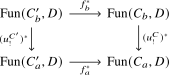 commutes by the induced identification. Thus precomposition with \(f\) preserves cartesian transport, and hence defines a cartesian functor over \(S\). This finishes the proof.