Theorem 13.4.1 (Universal Grothendieck construction). There is a canonical equivalence
\[
\Cat_{/\Cat} \iso \Fun^{\mathrm{coCart}}_{\Cart}([1],\Cat)
\]
assigning to each pullback square of the form
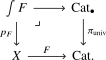 the functor \(p_F\), seen as a term of \(\Fun^{\mathrm{coCart}}_{\Cart}([1],\Cat)\).
Proof
We have a functor
\[
\Fun^{\mathrm{coCart}}_{\Cart}([1],\Cat)\iso
\Fun^{\mathrm{coCart}}_{\Cart}([1],\Cat)_{/\univ}
\to \Cat_{/\Cat}\, .
\]
We observe that the induced map
\[
\Map([1],\Fun^{\mathrm{coCart}}_{\Cart}([1],\Cat))\to
\Map([1],\Cat_{/\Cat})
\]
is an equivalence: this means that pullback squares of the form
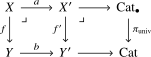 with \(Y\) and \(Y'\) small categories are uniquely determined by diagrams of the form
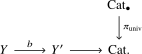 The inverse is given by the rule \((X,F)\mapsto p_F\).