Terminal objects require no compatibility condition on the morphisms being inverted. For binary products, we first show that localization commutes with products of categories. The unitality hypothesis below makes inversion in the product category detectable separately in each variable. We then descend the diagonal/product adjunction through localization to obtain cartesian products in the localized category.
14.1.1 Products of localized categories
Proposition 14.1.1 (Terminal objects). Let \(C\) be a category and \(W\hookrightarrow C\) a subcategory. If \(C\) has a terminal object then so does the localization \(L(C,W)\) and the localization functor \(\gamma\colon C\to L(C,W)\) preserves terminal objects.
Proof
Let \(t\colon *\to C\) be a terminal object. The functor \(t\) is terminal by Proposition 9.1.13, and the localization functor \(\gamma\) is terminal by Proposition 9.1.9. Since terminal functors are stable under composition, \(\gamma t\colon *\to L(C,W)\) is terminal. Another application of Proposition 9.1.13 shows that \(\gamma(t)\) is a terminal object.
Definition 14.1.2 (Wide subcategory). A subcategory \(W\) of a category \(C\) is wide if it contains every object of \(C\).
Proposition 14.1.3 (Products of localizations). Let \(C\) and \(C'\) be two categories, with wide subcategories \[ W\hookrightarrow C\quad\text{and} \quad W'\hookrightarrow C' \] respectively, and associated localization functors \[ \gamma\colon C\to L(C,W)\quad\text{and}\quad \gamma'\colon C'\to L(C',W')\, . \] Then the functor \[ \gamma\times\gamma'\colon C\times C'\to L(C,W)\times L(C',W') \] induces an equivalence \[ L(C\times C',W\times W')\iso L(C,W)\times L(C',W')\, . \]
Proof
Let \(\varphi\colon C\times C'\to D\) be any functor.
Given morphisms \(f\colon x\to y\) and \(f'\colon x'\to y'\) in \(C\) and \(C'\) respectively,
we have a canonical commutative square of the form below.
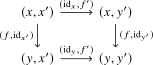 Since both \(W\) and \(W'\) are wide, all identities of \(C\) belong to \(W\) and all identities of \(C'\)
belong to \(W'\). Consequently, the property for the functor \(\varphi\) to send all morphisms in \(W\times W'\)
to isomorphisms is equivalent to the conjunction of the following two properties:
• For any morphism \(f\colon x\to y\) in \(W\) and any object \(x'\) of \(C'\), the morphism \(\varphi(f,\id_{x'})\) is an isomorphism in \(D\).
• For any morphism \(f'\colon x'\to y'\) in \(W'\) and any object \(x\) of \(C\), the morphism \(\varphi(\id_x,f')\) is an isomorphism in \(D\).
In other words, the currying equivalence \[ \Fun(C\times C',D)\iso\Fun(C,\Fun(C',D)) \] restricts to an equivalence \[ \Fun^{W\times W'}(C\times C',D)\iso\Fun^W(C,\Fun^{W'}(C',D)) \] functorially in \(D\). This implies that there is a canonical equivalence \[\Fun^{W\times W'}(C\times C',D)\iso\Fun(L(C,W),\Fun(L(C',W'),D))\, . \] Using the equivalence \[ \Fun(L(C,W)\times L(C',W'),D)\iso\Fun(L(C,W),\Fun(L(C',W'),D)) \] it follows that the functor \(\gamma\times\gamma'\) exhibits \(L(C,W)\times L(C',W')\) as a localization of \(C\times C'\) at \(W\times W'\).
Corollary 14.1.4 (Finite products of geometric realizations). The geometric realization functor \[ \Pi_{\infty}\colon\Cat\to\An \] preserves finite products.
Proof
The terminal category \(e\) is already a terminal anima, so \(\Pi_{\infty}(e)\iso e\). For binary products, apply Proposition 14.1.3 with \(W=C\) and \(W'=C'\). Localization at all morphisms is geometric realization, and hence the resulting equivalence is \[ \Pi_{\infty}(C\times C')\iso\Pi_{\infty}(C)\times\Pi_{\infty}(C'). \]
14.1.2 Cartesian localizations
To construct products inside a single localization, we transport the diagonal/product adjunction. We first record the general fact that an adjunction descends whenever both adjoints preserve the chosen subcategories.
Lemma 14.1.5 (Adjunctions descend to localizations). Let \(F\colon C\rightleftarrows D\colon G\) be an adjunction.
We consider two subcategories
\[
V\hookrightarrow C\quad\text{and}\quad W\hookrightarrow D
\]
respectively, and we assume that \(F\) sends every morphism in \(V\) to a morphism in \(W\),
and, conversely, that \(G\) sends every morphism in \(W\) to a morphism in \(V\).
Then there is an induced adjunction of the form
\[
\bar F\colon L(C,V)\rightleftarrows L(D,W)\colon \bar G
\]
with canonical commutative squares
 Furthermore, if \(\eta\colon\id_C\to GF\) and \(\varepsilon\colon FG\to\id_D\)
are the unit and counit of the original adjunction, then the unit and counit
of the induced adjunction satisfy
\[
\bar\eta_{\gamma_C(x)}=\gamma_C(\eta_x)
\qquad\text{and}\qquad
\bar\varepsilon_{\gamma_D(y)}=\gamma_D(\varepsilon_y)
\]
under the displayed identifications, for objects \(x\) of \(C\) and \(y\) of \(D\).
Proof
Write \(\gamma_C\colon C\to L(C,V)\) and \(\gamma_D\colon D\to L(D,W)\) for the localization functors. Since \(F\) sends \(V\) into \(W\) and \(G\) sends \(W\) into \(V\), functoriality of localization gives functors \(\bar F\) and \(\bar G\) together with identifications \[ \alpha\colon\bar F\gamma_C\iso\gamma_DF \qquad\text{and}\qquad \beta\colon\bar G\gamma_D\iso\gamma_CG. \]
After these identifications, applying \(\gamma_C\) to the unit \(\eta\colon\id_C\to GF\) gives a natural transformation \[ \gamma_C\longrightarrow\bar G\bar F\gamma_C. \] The universal property of \(\gamma_C\) identifies this with a unique natural transformation \[ \bar\eta\colon\id_{L(C,V)}\longrightarrow\bar G\bar F. \] Similarly, applying \(\gamma_D\) to the counit \(\varepsilon\colon FG\to\id_D\) produces a unique natural transformation \[ \bar\varepsilon\colon\bar F\bar G\longrightarrow\id_{L(D,W)}. \] The two triangle identities for \(\bar\eta\) and \(\bar\varepsilon\) can be checked after precomposition with \(\gamma_C\) and \(\gamma_D\), respectively, because precomposition with a localization functor is fully faithful. After precomposition and transport along \(\alpha\) and \(\beta\), the first triangle is \(\gamma_D\) applied to the triangle for \(F\), while the second is \(\gamma_C\) applied to the triangle for \(G\). Thus \(\bar F\) is left adjoint to \(\bar G\). The assertions about the components of the unit and counit follow from their construction.
Proposition 14.1.6 (Cartesian localizations). Let \(C\) be a category and \(W\hookrightarrow C\) a wide subcategory. We assume that \(C\) has binary cartesian products and that \(W\) is stable under cartesian product in the sense that, for any morphisms \(f\) and \(g\) in \(W\), the induced morphism \(f\times g\) belongs to \(W\). Then the localization \(L(C,W)\) has binary cartesian products and the localization functor \(\gamma\colon C\to L(C,W)\) commutes with them.
Proof
There is an adjunction \[ \Delta\colon C\rightleftarrows C\times C\colon (-)\times (-) \] where \(\Delta\) is the functor defined by the rule \(x\mapsto (x,x)\). The property that \(W\) is stable under binary cartesian product precisely means that Lemma 14.1.5 applies in this situation, yielding an adjunction of the form \[ \bar{\Delta}\colon L(C,W)\rightleftarrows L(C\times C,W\times W)\colon\overline{(-)\times (-)}\, . \] But, since \(W\) is wide, Proposition 14.1.3 provides a canonical equivalence \[ L(C\times C,W\times W)\iso L(C,W)\times L(C,W) \] whose composition with \(\bar{\Delta}\) is the diagonal functor \[ L(C,W)\to L(C,W)\times L(C,W)\ , \qquad x\mapsto (x,x)\, . \] This proves the existence of cartesian products in \(L(C,W)\). Under the equivalence above, the compatibility square for the right adjoint from Lemma 14.1.5 identifies \(\overline{(-)\times(-)}(\gamma(x),\gamma(y))\) with \(\gamma(x\times y)\). Thus \(\gamma\) preserves binary cartesian products.
The universal property has now supplied finite products in the localization. We next study localization functors that themselves participate in an adjunction and identify their local objects.