Theorem 12.3.3 (Parametrized evaluation). Consider a category \(C\) equipped with a functor \(\Phi\colon C \to \An\), and let \(q\colon \int \Phi \to C\) denote the associated left fibration:
 Then there exists a canonical pullback square of the form
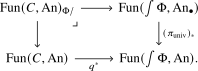
Proof
Both sides of the asserted square are left fibrations over \(\Fun(C,\An)\). We first construct a comparison between them and then prove that it is an equivalence by identifying its fiber over each functor \(\Psi\colon C\to\An\). The final part of the proof checks that the resulting fiberwise equivalence is the canonical one supplied by straightening.
Consider the following pullback square:
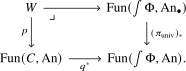 The pair \(w=(q,\Phi_{\bullet})\) determines an object \(w : W^\simeq\) such that \(p(w)=\Phi\).
Since \(p\) is a left fibration, this determines a unique functor
\[
f\colon \Fun(C,\An)_{\Phi/}\to W
\]
over \(\Fun(C,\An)\) such that \(f(\Phi)=w\). To prove the theorem, it suffices to prove that \(f\)
is an equivalence. Since this is a functor between two left fibrations over \(\Fun(C,\An)\),
it suffices to check this on fibers over any object of \(\Fun(C,\An)\).
Finally, up to replacing the underlying anima context,
it suffices to consider fibers defined in the absolute context.
Consider an arbitrary object \(\Psi\) of \(\Fun(C,\An)\) (in the absolute context).
The fiber of \(\Fun(C,\An)_{\Phi/}\) over \(\Fun(C,\An)\) is by definition the mapping anima
\[
{\Fun(C,\An)}(\Phi,\Psi).
\]
By straightening/unstraightening (Theorem 8.3.15),
this is equivalent to the relative mapping anima \(\Map_C(\int\Phi, \int \Psi)\) over \(C\).
Since \(\int \Psi\) sits in a pullback square of the form
 we have by adjunction the equivalence below,
in which \(\int \Phi\) is seen over \(\An\) with structural map \(\Psi\circ q\).
\[
\Map_C\left(\int\Phi, \int \Psi\right) \iso \Map_{\An}\left(\int \Phi, \An_{\bullet}\right)
\]
We also have the following canonical pullback
squares (the first one by definition and the second one by conservativity of left fibrations).
 It remains to check that the map induced by \(f\) on fibers over \(\Psi\) is the composition
\[
{\Fun(C,\An)}(\Phi,\Psi)\iso \Map_C\left(\int\Phi, \int \Psi\right) \iso \Map_{\An}\left(\int \Phi, \An_{\bullet}\right)\, .
\]
A map \(u\colon \Phi\to\Psi\) can be seen as a functor \(u\colon [1]\to\Fun(C,\An)\).
Since \(f(\Phi)=w\), there is a unique functor \(v\colon [1]\to W\)
such that \(p(v)=u\). By definition, we then have \(f(u)=v\).
On the other hand the straightening/unstraightening equivalence consists in interpreting \(u\)
as a functor \(\tilde{u}\colon [1]\times C\to\An\) corresponding to a left fibration
\(q\colon X\to [1]\times C\) and to apply
Construction 8.2.1.
In other words, we see \([1]\times \int\Phi\) over \([1]\times C\) by pulling back \(\int\Phi\)
along the projection \([1]\times C\to C\), which we interpret by transposition as a functor
\[
\bar{u}\colon [1]\to \Fun(\int\Phi,[1]\times C)
\]
and we consider the unique lifting of \(\bar{u}\) of the form
\[
\bar{v}\colon [1]\to\Fun(\int\Phi,X)
\]
with source the composition of the embedding of the fiber \(X_0\hookrightarrow X\)
with the identification of \(\int\Phi\) with the fiber \(X_0\).
In other words, we consider the commutative square
 and pick the lower horizontal line in the image of this square by \(f\).
This is indeed the same as applying \(f\) directly.