Lemma 20.6.3. Let \(A\) be a Waldhausen category in which weak equivalences all are isomorphisms. The functor \[ (\ker,\coker)\colon\ExactSeq(A)\to A\times A \] induces a morphism of simplicial animae \[ \Scons(\ExactSeq(A))^\simeq\to \Scons(A)^\simeq\times\Scons(A)^\simeq \] that yields an isomorphism after geometric realization.
Proof
We have a commutative triangle of the form
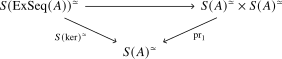 and we will apply Lemma 20.6.1 to it.
We consider a map
\[
x\colon \Delta^n\to \Scons(A)
\]
i.e. a functor \(x\colon\Fun([1],[n])\to A\) satisfying the conditions of
Definition 20.5.4.
We have to prove that the induced map
\[
\Delta^n\times_{\Scons(A)^\simeq} \Scons(\ExactSeq(A))^\simeq
\to \Delta^n\times_{\Scons(A)^\simeq}(\Scons(A)^\simeq\times \Scons(A)^\simeq)
\]
induces an isomorphism after geometric realization. We will consider first the case where \(n=0\).
In that case \(x\) simply is the initial object \(*\) in \(A\).
It suffices to check that the comparison map between pullbacks above
is an equivalence of simplicial animae, which can be checked objectwise.
If we evaluate at \([p]\), this is the same as evaluating at \(0\), up
to replacing \(A\) by \(\Wald([p+1],A)\). Therefore, it suffices to check that
we have an equivalence when we evaluate at \([0]\).
The left hand side is then the collection of pushout squares of the form
 whereas the right hand side is the collection of pairs of objects of the form \((*,x'')\).
It is clear that assigning \(x''\) to each pushout square as above is an equivalence.
Let us consider the general case. Let us write \(x_0\colon\Delta^0\to \Scons(A)\)
for the restriction of \(x\) along \(\{0\}\hookrightarrow\Delta^n\).
This induces a pullback square of the form
 in which the upper horizontal map is an equivalence (by the preceding discussion).
Therefore, it suffices to check that the two vertical maps induce an isomorphism
after geometric realization. But the vertical map \(j\) on the right is equivalent to
\[
\Scons(A)^\simeq\iso\{0\}\times\Scons(A)^\simeq\hookrightarrow
\Delta^n\times\Scons(A)^\simeq\, .
\]
Since the geometric realization functor commutes with finite products
(because \(\Delta\catop\) is sifted), it suffices to check that any
map of the form \(\Delta^0\to \Delta^n\) induces an isomorphism after geometric
realization. This follows from the fact that the geometric realization of \(\Delta^n\)
is contractible (as is the colimit of any representable presheaf on a small category).
What precedes tells us that \[ \Delta^0\times_{\Scons(A)^\simeq} \Scons(\ExactSeq(A))^\simeq\simeq\Scons(A)^\simeq\, . \] There is a canonical map \[ p\colon \Delta^n\times_{\Scons(A)^\simeq} \Scons(\ExactSeq(A))^\simeq\to \Scons(A)^\simeq) \] obtained through the second projection \[ \Delta^n\times_{\Scons(A)^\simeq} \Scons(\ExactSeq(A))^\simeq \to \Scons(\ExactSeq(A))^\simeq \] followed from the map \[ \Scons(\ExactSeq(A))^\simeq\to \Scons(A)^\simeq \] induced by the functor \[ \coker\colon\ExactSeq(A)\to A\, . \] It is immediate to see that the vertical map \(i\) on the left hand side of the square above is a section of \(p\). It suffices now to prove that the other composite \(i\circ p\) simplicially homotopic to the identity.
Let \(h\colon\Delta^1\times\Delta^n\to\Delta^n\) be the map induced by the functor expressing the fact that \(n\) is a terminal object of \([n]\).
Keeping track of the notations of Remark 20.6.2,
for any maps \(u\colon [m]\to [n]\) and \(v\colon[m]\to [1]\) to the unique natural transformation
\[
\kappa_{u,v}\colon u\to \bar u
\]
produces a canonical map
\[
\kappa_{u,v,x}\colon u^*(x)\to \bar{u}^*(x)
\]
functorially in \((u,v)\).
A term of the category \(\Delta_{/X}\) for
\[
X=\Delta^1\times \Big(\Delta^n\times_{\Scons(A)^\simeq}\Scons(\ExactSeq(A))^\simeq\Big)
\]
literally is a tuple of the form \((u,v,\xi)\) with \((u,v)\) as above any \(\xi\) a tern of the category of
pushout square in \(A\) of the form below.
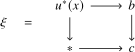 Such a term \(\xi\) is thus canonically the back face of a term of the category of
commutative cubes in \(A\) of the form
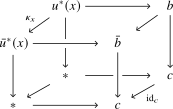 in which the back face, the front face, as well as the top face are pushout squares.
We define
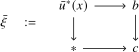 and the rule
\[
H(u,v,\xi)=(\bar{u},\bar{\xi})
\]
produces a well-defined functor over \(\Delta\), hence a morphism of simplicial animae
\[
H\colon
\Delta^1\times \Big(\Delta^n\times_{\Scons(A)^\simeq}\Scons(\ExactSeq(A))^\simeq\Big)
\to
\Delta^n\times_{\Scons(A)^\simeq}\Scons(\ExactSeq(A))^\simeq
\]
which is a homotopy between the identity and \(i\circ p\).