Construction 8.8.2. Let \(C\) be a category with pullbacks.
There is a functor
\[
\delta\colon\Fun([1],C)\to\Fun([1],C)
\]
sending each morphism \(f\colon x\to y\) in \(C\) to the diagonal map \(\delta_f\colon x\to x\times_y x\), induced by the canonical commutative square
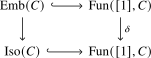
 in \(C\). We define the category of embeddings of \(C\) as the full subcategory of \(\Fun([1],C)\) spanned
by embeddings in \(C\). In other words, this is the category obtained by forming the
following pullback square.
 For \(C=\Cat\), we define the categories of pairs of small categories
as
\[
\Pair=\mathrm{Emb}(\Cat)
\]
Thus \(\Pair\) is the category of small categories equipped with a chosen subcategory. The
localization functor constructed below will universally invert the morphisms in that chosen
subcategory.
By a slight abuse of notation, we will often think of objects in \(\Pair\) as a pair \((C,W)\) where \(C\) is
a small category and \(W\) a subcategory of \(C\) (which makes sense, using
Proposition 6.4.5).
There is a functor
\[
\ev_1\colon\Pair\to\Cat
\]
sending \((C,W)\) to \(C\). The latter has a unique section
\[
(-)^\flat\colon\Cat\to\Pair
\]
with the property of sending each small category \(C\) to the pair \(C^\flat=(C,C^\simeq)\).
The functor \((-)^\flat\) is easily seen to be fully faithful (this boils down to the fact that any functor
sends isomorphisms to isomorphisms).