Construction 8.1.2. Let \(p\colon C \to S\) and \(q\colon D \to S\) be two cocartesian fibrations, and let \(f\colon C \to D\) be a functor over \(S\). We will construct a category \(\isCocart(f)\) whose objects are proofs that \(f\) is a cocartesian functor.
Recall from Corollary 6.5.9 that a functor \(f\colon C \to D\) over \(S\) is a cocartesian functor over \(S\) if and only if for every morphism \(v\colon x \to y\) in \(S\) and for every object \(c \in C(x)\) a certain canonical map \(\BC_!(v,c)\colon v_!f(c) \to f(v_!c)\) is an isomorphism in \(D\). This map is natural in the pair \((v,x)\), in the sense that it is part of a natural transformation of functors \(C \vectimes{p} S \to D\). Precomposing with the directed evaluation functor \(\vec{\ev}\colon \Fun([1],C) \to C \vectimes{p} S\), we thus obtain a functor \[ \BC_!\colon \Fun([1],C) \to \Fun([1],D) \] and \(f\) is a cocartesian functor over \(S\) if and only if \(\BC_!\) factors through the subcategory \(D \simeq \Iso(D) \hookrightarrow \Fun([1],D)\) of isomorphisms.
Consider now the following pullback square:
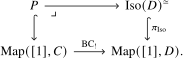 Consider also the map \(p = p_{\Map([1],C)}\colon \Map([1],C) \to *\). We then define
\[
\isCocart(f) := p_*(P),
\]
where \(p_*(P)\) denotes the dependent product of \(P\) along \(p\) as defined in Definition 3.5.2.