Corollary 6.5.9. Let \(p\colon A \to S\) and \(q\colon B \to S\) be two cocartesian fibrations, and consider a commutative triangle
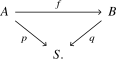 Then \(f\) is a cocartesian functor over \(S\) if and only if for every morphism \(v\colon x \to y\) in \(S\) and every object \(a\) of \(A(x)\), the map \(\overline{v}\colon v_!(f(a)) \to f(v_!(a))\) is an isomorphism.
Proof
By definition, \(f\) is a cocartesian functor if and only if the natural transformation
\[
\BC_!\colon \lift^q_0 \vec{f} \to f_*\lift^p_0
\]
constructed in Construction 4.7.1 is a natural isomorphism. By Corollary 6.4.20, this may be tested pointwise. Thus, it is equivalent to asking that for every morphism \(v\colon x \to y\) in \(S\) and every object \(a\) of \(A(x)\), the morphism \(\BC_!(a,v)\) in \(\Fun([1],B)\) is an isomorphism. This morphism takes the form of a commutative square
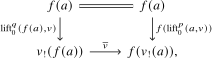 and by Corollary 6.4.17 this is in turn equivalent to asking both horizontal maps to be isomorphisms. Since the top horizontal morphism is an identity map and thus always an isomorphism, this finishes the proof.
From Section 6.5, Pointwise and fiberwise criteria for fibrations.