Lemma 8.3.14. Given functors \(F_0,F_1\colon S \to U\), the fiber of the functor \[ \Fun(S, \CoCart_{U \times U}(U_{\bullet} \times U, U \times U_{\bullet})) \to \Fun(S, U) \times \Fun(S, U) \] at the pair \((F_0,F_1)\) is \(\Map_S^{\CoCart}(E_0,E_1)\).
Proof
The fibers of this functor are animae: indeed, we are considering the fibers of a functor equivalent to \[ \Fun(S,\Fun([1],U))\simeq\Fun([1],\Fun(S,U))\to\Fun(S,U)\times\Fun(S,U)\, , \] and since the latter is known to be conservative, this proves our claim. Consider an anima \(\Gamma\). Then a map \(\Gamma \to \Map_S^{\CoCart}(E_0,E_1)\) corresponds by definition to a cocartesian functor \(f\colon \Gamma \times E_0 \to \Gamma \times E_1\) over \(\Gamma \times S\).
On the other hand, a map from \(\Gamma\) to the fiber is given as a map \(Y_0 \to Y_1\) over \(\Gamma \times S\) together with a proof that it is a cocartesian functor over \(\Gamma \times S\), where \(Y_0\) and \(Y_1\) are defined via the pullback squares
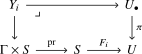 But it is easy to see that \(Y_0\) and \(Y_1\) are equivalent to \(\Gamma \times E_0\) and \(\Gamma \times E_1\), respectively.