Construction 15.2.5. Let \(C\) be a Segal anima. An object of \(C\) is a term of \(C_0\). A morphism of \(C\) simply is a term of \(C_1\). We define the composition law of morphisms in \(C\) as the composition of the inverse of the equivalence \[ C_2=\Hom(\Delta^2,C)\iso\Hom(\segal{2},C)\simeq C_1\times_{C_0}C_1 \] with the map \[ d^1\colon C_2\to C_1\, . \] This defines a morphism \[ C_1\times_{C_0}C_1\to C_1\ , \quad (f,g)\mapsto g\circ f\, . \] Thus, if \(\sigma:C_2\) denotes the unique \(2\)-simplex whose spine is \((f,g)\), we have \(g \circ f = d_1(\sigma)\).
A morphism \(f\colon x\to y\) in \(C\) is a term \(f : C_1\) with identifications of the form \(s : d^1(f)=x\) and \(t : d^0(f)=y\). For instance, given any object \(x\) of \(C\), there is the morphism \(\id_x\colon x\to x\) defined as the image of \(x : C_0\) through the map \(C_0\to C_1\) induced by \(\Delta^1\to\Delta^0\). The Segal equivalence in degree \(3\) associates to any composable triple \[ x\xrightarrow{f}y\xrightarrow{g}z\xrightarrow{h}t \] a unique \(3\)-simplex. Applying its face maps in the two possible orders identifies the two composites and gives \[ a_{f,g,h}\colon (h\circ g)\circ f=h\circ(g\circ f). \] Likewise, the degenerate \(2\)-simplices give the left and right unit identifications \(\id_y\circ f=f\) and \(f\circ\id_x=f\). The unique \(4\)-simplex associated to four composable morphisms gives the pentagon coherence for \(a\), while the degenerate \(3\)-simplices give the triangle coherences involving the unit identifications. We will use these identifications and coherences without further mention.
A morphism \(f\colon x\to y\) in \(C\) is an isomorphism if there are morphisms
\(g\colon y\to x\) and \(h\colon y\to x\) together with identifications of the form
\[
l : g\circ f=\id_x\quad\text{and}\quad r : f\circ h=\id_y\, .
\]
Isomorphisms form an anima \(\Iso(C)\) equipped with a forgetful map
\[
\Iso(C)\to C_1\ , \quad (f,g,h,l,r)\mapsto f
\]
and there is a canonical proof that \(\id_x\) is an isomorphism in \(x\), yielding a canonical map
\[
\id\colon C_0\to\Iso(C)\, .
\]
More precisely, \(\Iso(C)\) is defined through the following diagram.
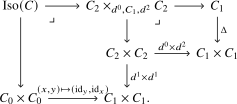 Given \(x,y : C_0\), we denote by \(x\iso y\) the fiber of the map \(\Iso(C)\to C_0\times C_0\)
at \((x,y)\).