The spine can also be viewed as the union of the consecutive edges and vertices inside a simplex. We justify this description by first discussing unions in a category of presheaves. The comparison at the end identifies this union with the recursive pushout construction of Construction 15.2.1.
Construction 15.3.1 (Unions in categories of presheaves). Let \(C\) be a small category and \(X\colon C\catop\to\An\) a presheaf.
Let \(I^\simeq\) be a small subanima of
\((\PSh(C)_{/X})^\simeq\) consisting of embeddings
\[
U\hookrightarrow X
\]
and we assume that the following conditions hold:
for any \(U\hookrightarrow X\) and \(V\hookrightarrow X\) in \(I\), the
pullback \(U\times _X V\hookrightarrow X\) is either in \(I^\simeq\) or is empty (i.e.
\(\emptyset\simeq U\times_XV\)).
We form the full subcategory \(I\) of \(\PSh(C)_{/X}\) spanned by \(I^\simeq\).
We thus have a canonical functor
\[
\varphi\colon I\to\PSh(C)
\]
defined by \(\varphi(U\hookrightarrow X)=U\) and a cocone \(c\colon\varphi\to \const_I(X)\)
induced by the embeddings \(U\hookrightarrow X\), hence a canonical map
\[
j\colon \underset{U\hookrightarrow X : I}{\colim}\ U\to X\, .
\]
The presheaf category and its slice over \(X\) are locally small. Hence \(I\)
is small by Proposition 11.2.18, applied to its small anima
of objects.
The colimit of the \(U\)’s above is called the union of the family \(I\) in \(X\).
This terminology is justified by the following lemma.
Lemma 15.3.2. The map \(j\colon \colim_I\varphi \to X\) constructed above is an embedding. More precisely, it induces an equivalence of the form \[ \underset{U\hookrightarrow X : I}{\colim}\ U\simeq\underset{\simp\catop}{\colim}\ \check{C}(T/X) \] with \(T=\sum_{U\hookrightarrow X : I^\simeq}\, U\to X\) the canonical map and \(\check{C}(T/X)\) defined as \(\check{C}(T/X)_c=\check{C}(T_c/X_c)\) for all \(c : C\).
Proof
Let \(Z=\colim_{\simp\catop} \check{C}(T/X)\). For each object \(c\) of \(C\), since the evaluation at \(c\) commutes with small limits and with small colimits, the evaluation of \(Z\) at \(c\) is the colimit of \(\check{C}(T_c/X_c)\), hence the canonical map \(Z_c\to X_c\) is an embedding, by Corollary 11.1.12. Since evaluation at \(C^\simeq\) is conservative, this shows that we have a canonical embedding \(Z\hookrightarrow X\). Replacing \(X\) by \(Z\), we may assume, without loss of generality, that \(Z=X\) (or, equivalently, that the map \(T\to X\) is a cover fiberwise).
Let \(c\) be an object of \(C\). We want to prove that the colimit of the \(U(c)\)’s is \(X(c)\).
We consider then the following pullback squares.
 We now have
\[
\underset{U\hookrightarrow X : I}{\colim}\ U(c)\simeq
\geom{J}\, .
\]
The embeddings \(U(c)\hookrightarrow X(c)\) induce a functor \(J\to I\times X(c)\)
hence a projection \(\pr\colon J\to X(c)\).
It suffices to check that \(J\) is weakly contractible in context \(X(c)\).
Since \(T(c)\to X(c)\) is a cover, it is in fact sufficient to prove it in context \(T(c)\).
It is thus sufficient to prove this in each context \(U(c)\) for each embedding \(U(c)\hookrightarrow X(c)\).
The fiber \(F\) of the projection \(\pr\) over \(U(c)\) is the full subcategory of \(J\) spanned by
those pairs consisting of an embedding \(V\hookrightarrow X\) together with a term of \(U(c)\times_{X(c)}V(c)\)
in context \(U(c)\), i.e. a proof that the first projection \(U(c)\times_{X(c)}V(c)\iso U(c)\)
is an equivalence. We thus have a functor
\[
\varphi\colon F\to F\ , \quad V\longmapsto U\times_X V
\]
and the second projection \(U\times_X V\to V\) defines a map from \(\varphi\)
to \(\id_F\).
On the other hand, the first projection \(U\times_XV \to U\) defines a map from \(\varphi\)
to the constant functor with value \(U\) (together with the proof that \(U(c)\times_{X(c)}U(c)\iso U(c)\)),
proving that \(F\) is weakly contractible.
Example 15.3.3. Let \(C\) be a small category and \(X\colon C\catop\to\An\) a presheaf.
We consider two embeddings \(U\hookrightarrow X\) and \(V\hookrightarrow X\).
We denote by
\[
U\cap V:=U\times_XV \hookrightarrow X
\]
the embedding of the fiber product of \(U\) and \(V\) over \(X\).
The union of \(U\) and \(V\) in \(X\), denoted by \(U\cup V\), is the colimit of the
diagram of embeddings
\[
U\hookrightarrow X\, , \ V\hookrightarrow X\ \text{and\ } U\cap V\hookrightarrow X\, .
\]
The previous lemma tells us that we have a canonical embedding
\[
U\cup V\hookrightarrow X\, .
\]
In fact, one can check that the induced commutative square
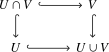 is both cartesian and cocartesian. Indeed, since \(U\cup V\) embeds in \(X\), to check that it is a pullback
square, it suffices to do it after replacing \(U\cup V\) by \(X\), and this holds then by definition.
To prove that it is cocartesian, let \(I\) be the full subcategory of all
embeddings with codomain \(X\) spanned by the embeddings with domain \(U\), \(V\)
or \(U\cap V\). For every presheaf \(Y\), a cocone from the diagram indexed by
\(I\) to \(Y\) is precisely a pair of maps \(U\to Y\) and \(V\to Y\) whose
restrictions to \(U\cap V\) agree. Indeed, any additional morphism in \(I\)
comes from a containment among \(U\) and \(V\), and its compatibility is already
forced by this agreement. Thus the presentation
\[
U\cup V=\underset{W\hookrightarrow X : I}{\colim}\ W
\]
has the universal property of the displayed pushout square.
Proposition 15.3.4 (The spine as a union). The canonical map \(i_n\colon\segal{n}\to\Delta^n\) is an embedding. It identifies \(\segal{n}\) with the union of the vertices and consecutive edges of \(\Delta^n\).
Proof
We argue by induction on \(n\), the case \(n=0\) being immediate. Inside \(\Delta^{n+1}\), the initial face \(\Delta^n\) and the last edge \(\Delta^1\) meet in their common vertex \(n\). Indeed, a simplex factors through both precisely when it is constant at that vertex. By induction, \(\segal{n}\) embeds in this initial face and contains its last vertex. Hence its intersection with the last edge is also \(\Delta^0\). By Example 15.3.3, their union is therefore the pushout \[ \segal{n}\amalg_{\Delta^0}\Delta^1=\segal{n+1}. \] Its map into \(\Delta^{n+1}\) is \(i_{n+1}\), so this map is an embedding with the asserted image.