Example 15.3.3. Let \(C\) be a small category and \(X\colon C\catop\to\An\) a presheaf.
We consider two embeddings \(U\hookrightarrow X\) and \(V\hookrightarrow X\).
We denote by
\[
U\cap V:=U\times_XV \hookrightarrow X
\]
the embedding of the fiber product of \(U\) and \(V\) over \(X\).
The union of \(U\) and \(V\) in \(X\), denoted by \(U\cup V\), is the colimit of the
diagram of embeddings
\[
U\hookrightarrow X\, , \ V\hookrightarrow X\ \text{and\ } U\cap V\hookrightarrow X\, .
\]
The previous lemma tells us that we have a canonical embedding
\[
U\cup V\hookrightarrow X\, .
\]
In fact, one can check that the induced commutative square
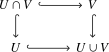 is both cartesian and cocartesian. Indeed, since \(U\cup V\) embeds in \(X\), to check that it is a pullback
square, it suffices to do it after replacing \(U\cup V\) by \(X\), and this holds then by definition.
To prove that it is cocartesian, let \(I\) be the full subcategory of all
embeddings with codomain \(X\) spanned by the embeddings with domain \(U\), \(V\)
or \(U\cap V\). For every presheaf \(Y\), a cocone from the diagram indexed by
\(I\) to \(Y\) is precisely a pair of maps \(U\to Y\) and \(V\to Y\) whose
restrictions to \(U\cap V\) agree. Indeed, any additional morphism in \(I\)
comes from a containment among \(U\) and \(V\), and its compatibility is already
forced by this agreement. Thus the presentation
\[
U\cup V=\underset{W\hookrightarrow X : I}{\colim}\ W
\]
has the universal property of the displayed pushout square.