We now study how to change the anima of objects of a Segal anima. Given \(X\) and a map \(e\colon E\to X_0\), we construct a Segal anima \(e^*(X)\) whose objects are parametrized by \(E\) and whose morphisms from \(x\) to \(y\) are the morphisms in \(X\) from \(e(x)\) to \(e(y)\). The construction is defined for arbitrary simplicial animae by pulling back their vertex data, and its universal property is expressed by a right adjoint.
Applied to the map on objects of \(f\colon X\to Y\), this gives a factorization of \(f\) into a map that is an equivalence on objects followed by a fully faithful map. For Segal animae, \(f\) is fully faithful precisely when the first map is an equivalence. We also prove the two-out-of-three property for Dwyer–Kan equivalences, which will be used in Corollary 15.5.6 to characterize the maps inverted by Rezk completion.
Construction 15.4.1. Let \(E : \An^\simeq\) be a small anima.
We form the following pullback square.
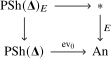 Alternatively, one can see \(E\) as a constant presheaf on \(\simp\) and form the
co-slice category \(\PSh(\simp)_{E/}\). The category \(\PSh(\simp)_E\)
is the full subcategory of \(\PSh(\simp)_{E/}\) whose objects are pairs \((X,e)\),
with \(X\) a presheaf on \(\simp\) and \(e\colon E\iso X_0\) an equivalence.
Proposition 15.4.2. The full embedding \(i_E\colon\PSh(\simp)_{E}\hookrightarrow\PSh(\simp)_{E/}\) has a right adjoint \((X,e)\mapsto (e^*(X),e_X)\).
Proof
Right Kan extension along \(\{[0]\}\hookrightarrow\simp\catop\) gives
an adjunction
\[
\ev_0\colon\PSh(\simp)\rightleftarrows\An\noloc\cosk_0.
\]
For a simplicial anima \(X\) equipped with \(e\colon E\to X_0\), define
\(e^*(X)\) by the pullback square
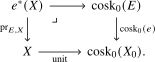 This is a pullback in \(\PSh(\simp)_{E/}\), with the maps
from the constant simplicial anima \(E\) induced by \(e\) and the adjunction.
The pointwise formula for right Kan extensions, Theorem 13.1.8, gives \[ \cosk_0(Y)_n\simeq \prod_{v : \Hom_\simp([0],[n])}Y\simeq Y^{n+1}, \] since the indexing category is the discrete category of vertices of \([n]\). The unit \(X\to\cosk_0(X_0)\) is therefore the map recording all vertices, so \[ e^*(X)_n\simeq X_n\times_{X_0^{n+1}}E^{n+1}. \] In particular, the structure map \(e_X\colon E\to e^*(X)_0\) is an equivalence, and \(\pr_{E,X}\) defines a morphism \((e^*(X),e_X)\to(X,e)\).
Let \(Y\) be a simplicial anima equipped with an equivalence \(f\colon E\iso Y_0\). For an anima \(Z\) under \(E\), the adjunction identifies maps \(Y\to\cosk_0(Z)\) under \(E\) with maps \(Y_0\to Z\) under \(E\). Since \(f\) is an equivalence, the anima of such maps is contractible. Apply this with \(Z=E\) and \(Z=X_0\). Mapping \((Y,f)\) into the defining pullback thus gives a natural equivalence \[ \Hom((Y,f),(e^*(X),e_X))\simeq\Hom((Y,f),(X,e)). \] This proves the required adjunction.
Remark 15.4.3. In the construction of the right adjoint in the proof of Proposition 15.4.2, we see that if \(X\) is a Segal anima, then so is \(e^*(X)\). In degree \(n\), the Segal map for \(e^*(X)\) is obtained from the Segal map for \(X\) by pulling back along \(E^{n+1}\to X_0^{n+1}\). It is therefore an equivalence.
Remark 15.4.4. Let \(f\colon X\to Y\) be a morphism of simplicial animae. We have a unique factorization of \(f\) of the form \[ X\xrightarrow{\ \tilde{f} \ }f^*_0(Y)\xrightarrow{\pr_{X_0,Y}}Y \] where \(\tilde{f}\) is a morphism in \(\PSh(\simp)_{X_0}\). Furthermore, the projection \(\pr_{X_0,Y}\) is in particular fully faithful. Indeed, its degree-one endpoint square is the defining pullback \[ f_0^*(Y)_1=Y_1\times_{Y_0\times Y_0}(X_0\times X_0). \]
Assuming that both \(X\) and \(Y\) are Segal animae, we observe the following properties:
(i) The morphism \(f\) is fully faithful if and only if \(\tilde{f}\) is an equivalence.
(ii) The morphism \(f\) is essentially surjective if and only if the projection \(\pr_{X_0,Y}\) is a Dwyer–Kan equivalence.
Indeed, property (i) is a direct consequence of Proposition 15.2.12 and property (ii) follows immediately from the definition of essential surjectivity.
Lemma 15.4.5. Let us consider two morphisms of Segal animae \(f\colon C\to D\) and \(g\colon D\to E\). If two out of the three morphisms \(f\), \(g\) or \(g\circ f\) are Dwyer–Kan equivalences, so is the third.
Proof
Since one can compose pullback squares as well as covers, it is clear that Dwyer–Kan equivalences are stable under composition.
Let us assume that \(f\) and \(g\circ f\) are Dwyer–Kan equivalences.
Since covers are stable under pullbacks and compositions,
it follows from Corollary 11.2.7 that \(g\) is essentially
surjective. We have to prove that the map
\[
D_1\to (D_0\times D_0)\times_{(E_0\times E_0)}E_1
\]
induced by \(g_1\) is an equivalence over \(D_0\times D_0\).
Let \(X=C_0\times_{D_0}\Iso(D)\) and \(q\colon X\to D_0\) be the map picking the codomain of isomorphisms.
Since \(q\times q\) is a cover, it suffices to prove that \(g_1\) is an equivalence after pulling back
along \(q\times q\) by Proposition 11.2.6.
But after such a pullback, \(q\times q\) has a section.
Furthermore, given \(u\colon a\iso b\) in a Segal anima \(C\),
we get equivalences of the form
\[
u^*\colon C(b,t)\to C(a,t)\quad\text{and}\quad u_*\colon C(t,a)\to C(t,b)
\]
for any \(t : C_0\) by
Lemma 15.2.6.
Therefore, it suffices to prove that \(g\) induces an equivalence
\[
D(f(x),f(y))\iso E(g(f(x)),g(f(y)))
\]
for any terms \(x,y : C_0\). This follows from the commutative triangles

Finally, assume that \(g\) and \(g\circ f\) are Dwyer–Kan equivalences. The pasting lemma for pullback squares (Lemma 1.6.11) shows that \(f\) is fully faithful. Consider the cover \[ q\colon P:=C_0\times_{g f,E_0,s}\Iso(E)\longrightarrow E_0, \qquad (x,u)\longmapsto t(u), \] which expresses the essential surjectivity of \(g\circ f\). Pulling it back along \(g_0\colon D_0\to E_0\) gives a cover \(P_D\to D_0\). A term of \(P_D\) over \(y : D_0\) consists of an object \(x : C_0\) and an isomorphism \(u\colon g(f(x))\iso g(y)\). Full faithfulness of \(g\), together with Lemma 15.2.11, identifies \(P_D\) with \[ C_0\times_{f,D_0,s}\Iso(D), \] by lifting \(u\) uniquely to an isomorphism \(\widetilde u\colon f(x)\iso y\). Consequently, the target map from the latter anima to \(D_0\) is a cover. This is precisely the essential surjectivity of \(f\), so \(f\) is a Dwyer–Kan equivalence.