Proposition 15.4.2. The full embedding \(i_E\colon\PSh(\simp)_{E}\hookrightarrow\PSh(\simp)_{E/}\) has a right adjoint \((X,e)\mapsto (e^*(X),e_X)\).
Proof
Right Kan extension along \(\{[0]\}\hookrightarrow\simp\catop\) gives
an adjunction
\[
\ev_0\colon\PSh(\simp)\rightleftarrows\An\noloc\cosk_0.
\]
For a simplicial anima \(X\) equipped with \(e\colon E\to X_0\), define
\(e^*(X)\) by the pullback square
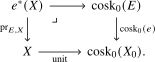 This is a pullback in \(\PSh(\simp)_{E/}\), with the maps
from the constant simplicial anima \(E\) induced by \(e\) and the adjunction.
The pointwise formula for right Kan extensions, Theorem 13.1.8, gives \[ \cosk_0(Y)_n\simeq \prod_{v : \Hom_\simp([0],[n])}Y\simeq Y^{n+1}, \] since the indexing category is the discrete category of vertices of \([n]\). The unit \(X\to\cosk_0(X_0)\) is therefore the map recording all vertices, so \[ e^*(X)_n\simeq X_n\times_{X_0^{n+1}}E^{n+1}. \] In particular, the structure map \(e_X\colon E\to e^*(X)_0\) is an equivalence, and \(\pr_{E,X}\) defines a morphism \((e^*(X),e_X)\to(X,e)\).
Let \(Y\) be a simplicial anima equipped with an equivalence \(f\colon E\iso Y_0\). For an anima \(Z\) under \(E\), the adjunction identifies maps \(Y\to\cosk_0(Z)\) under \(E\) with maps \(Y_0\to Z\) under \(E\). Since \(f\) is an equivalence, the anima of such maps is contractible. Apply this with \(Z=E\) and \(Z=X_0\). Mapping \((Y,f)\) into the defining pullback thus gives a natural equivalence \[ \Hom((Y,f),(e^*(X),e_X))\simeq\Hom((Y,f),(X,e)). \] This proves the required adjunction.