Lemma 15.2.11. If \(f\colon C\to D\) is a fully faithful morphism of Segal animae, then
there is a canonical pullback square of the form:
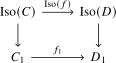
Proof
Since all four terms in the square are animae, the vertical maps are right fibrations. By Corollary 6.1.13, it therefore suffices to check the square on fibers. Let \(u\colon x\to y\) be a morphism in \(C\), in an arbitrary anima context. By the construction of \(\Iso(C)\), the fiber of \(\Iso(C)\to C_1\) over \(u\) is the anima of choices of a left and a right inverse for \(u\), together with the corresponding identifications: \[ \left(\sum_{g : C(y,x)}g\circ u=\id_x\right) \times \left(\sum_{h : C(y,x)}u\circ h=\id_y\right). \] Since \(f\) is fully faithful, it induces equivalences on all the hom animae appearing in this expression. These equivalences preserve identities and composition, and hence identify the displayed anima with the corresponding anima of inverse data for \(f(u)\) in \(D\). Thus the square induces an equivalence on every fiber and is a pullback square.