Corollary 15.5.6. A morphism of Segal animae \(f\colon C\to D\) is a Dwyer–Kan equivalence if and only if \(\ac(f)\colon\ac(C)\to\ac(D)\) is an equivalence.
Proof
The Rezk nerve functor being fully faithful, it is conservative.
Therefore, we might as well prove that Dwyer–Kan equivalences
are exactly those morphisms sent by the functor \(N\circ\ac\) to equivalences.
For any morphism of Segal animae \(f\colon C\to D\) we have a commutative square
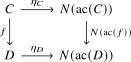 in which the two horizontal maps are Dwyer–Kan equivalences by
Theorem 15.5.1. Since the right vertical map is
a morphism of univalent Segal animae, we see that this corollary follows
immediately from the combination of Corollary 15.2.13
and Lemma 15.4.5.