Theorem 15.5.1. For any Segal anima \(X\), the unit map \[ \eta_X\colon X\to N(\ac(X)) \] is a Dwyer–Kan equivalence.
Proof of Theorem 15.5.1
Let \(X\) be a Segal anima. As explained in Construction 15.1.8,
we have canonical commutative square
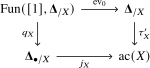 and Lemma 15.1.10
tells us that \(\tau'_X\) exhibits
\(\ac(X)\) as the localization of \(\simp_{/X}\) by last vertex maps.
Given \(n : \N\), the map
\[
(\eta_{X})_n\colon X_n\to N(\ac(X))_n
\]
sends \(\gamma : X_n\) to the composition of the functor \(j_X\) with the embedding
\[
[n]\hookrightarrow \simp_{\bullet/X}
\]
corresponding to the fiber of the cocartesian fibration
\[
\simp_{\bullet/X}\to\simp_{/X}
\]
at the object \(([n],\gamma)\).
An object of \(\Fun([1],\simp_{/X})\)
essentially is a pair \((u,\gamma)\) with
\(u\colon [m]\to [n]\) a morphism of \(\simp\) and \(\gamma : X_n\).
For any \(i : [n]^\simeq\), the projection
\[
[n]_{/i}\to [n]
\]
is a full embedding and induces an equivalence \([n]_{/i}\iso [i]\).
From there, we observe that, since \(m\) is a terminal object of \([m]\),
the property for \(u\) to be a right fibration is equivalent to the property that
\(u\) induces an equivalence \([m]\iso [n]_{/u(m)}\).
Using Remark 12.4.17, this implies that
one can describe \(\simp_{\bullet/X}\) as the full subcategory of \(\Fun([1],\simp_{/X})\)
whose objects are pairs \((u,\gamma)\) as above, such that \(u\) is a right fibration.
Let
\[
r\colon\simp_{\bullet/X}\to\Fun([1],\simp_{/X})
\]
be the resulting full embedding.
The functor \(q_X\) assigns to each pair \((u,\gamma)\) in \(\Fun([1],\simp_{/X})\)
the right fibration \([u(m)]=[n]_{/u(m)}\hookrightarrow [n]\) together
with the same \(\gamma : X_n\).
The canonical commutative square
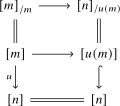 defines a map \(\eta_{(u,\gamma)}\colon(u,\gamma)\to r(q_X(u,\gamma))\) in \(\Fun([1],\simp_{/X})\).
We verify that these maps exhibit \(q_X\) as left adjoint to \(r\).
First, if \(u\) is a right fibration, then
\([m]\to[n]_{/u(m)}=[u(m)]\) is an equivalence. Consequently
\(q_Xr\iso\id_{\simp_{\bullet/X}}\).
It remains to verify the universal property of the unit. Let
\((v\colon[p]\hookrightarrow[q],\delta)\) be an object of
\(\simp_{\bullet/X}\), written as an initial-segment inclusion.
A morphism from \((u,\gamma)\) to its image under \(r\) contains a commutative
square
 Since \(\beta(u(m))=v(\alpha(m))\) lies in the initial segment \(v([p])\),
monotonicity implies that \(\beta(j)\) lies in \(v([p])\) for every
\(j\leq u(m)\). Hence \(\beta|_{[u(m)]}\) factors uniquely through \(v\).
Writing the factorization as \(\bar\alpha\colon[u(m)]\to[p]\), the equality
\(v\bar\alpha u=v\alpha\) and the fact that \(v\) is an embedding give
\(\bar\alpha u=\alpha\). We have therefore obtained a unique factorization
of the displayed square through \(\eta_{(u,\gamma)}\). The compatibility
with the labels in \(X\) is inherited from the original morphism. Thus
precomposition with \(\eta_{(u,\gamma)}\) induces the required equivalence
on hom animae, proving \(q_X\dashv r\) with \(r\) a right adjoint section.
The functor \(j_X=j_X\circ q_X\circ r\) is isomorphic to the functor \(\tau'_X\circ\ev_{0}\circ r\).
This implies that the map \[ (\eta_{X})_0\colon X_0\to N(\ac(X))_0=\ac(X)^\simeq \] is a cover. Indeed, \(\tau'_X\colon\simp_{/X}\to\ac(X)\) is a localization, so Corollary 11.2.16 gives a cover \[ (\simp_{/X})^\simeq=\sum_{n : \N}X_n\longrightarrow \ac(X)^\simeq. \] For any \(\gamma : X_n\), since \[ n\colon [0]\hookrightarrow [n] \] is a last vertex map, it induces an isomorphism from the image of \(([0],\gamma(n))\) to the image of \(([n],\gamma)\) in \(\ac(X)\). Hence the preceding cover factors, up to this canonical isomorphism, through the restricted map \(X_0\to \ac(X)^\simeq\). By cancellation for covers, this restricted map is already a cover.
It remains to prove that the morphism \(\eta_X\colon X\to N(\ac(X))\) is fully
faithful. Let us consider given \(x,y : X_0\). We have to prove that
the induced map
\[
(\eta_X)_{x,y}\colon X(x,y)\to N(\ac(X))(\eta_X(x),\eta_X(y))=\ac(X)(\eta_X(x),\eta_X(y))
\]
is an equivalence. Thanks to the last assertion of Lemma 15.5.3
together with the dual version of Proposition 14.3.9, there is a canonical
isomorphism of the form
\[
\Pi_{\infty}(W(d)_{c/})\iso
\ac(X)(\eta_X(x),\eta_X(y))
\]
with \(c=([0],x)\) and \(d=([0],y)\).
Under the canonical identification \(P_X(x,y)=X(x,y)\), these maps fit into
the commutative square
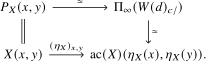 Here the upper map is induced by the initial embedding of the fiber from
Lemma 15.5.3, and the right-hand map is the
canonical fraction equivalence. To check commutativity, it suffices to apply
the square to the universal term \(u : X(x,y)\). Its image in \(W(d)_{c/}\) is
the fraction
\[
([0],x)\xrightarrow{\,0\,}([1],u)
\xleftarrow{\,1\,}([0],y),
\]
where the right-hand map is a last vertex map. The canonical fraction map
sends this term to the composite
\[
\tau'_X([0],x)\longrightarrow\tau'_X([1],u)
\xrightarrow{\ \simeq\ }\tau'_X([0],y),
\]
where the second arrow is the inverse of the image of the last vertex map.
On the other hand, the description of \(\eta_X\) above and the isomorphism
\(j_X\simeq\tau'_X\circ\ev_0\circ r\) identify \(\eta_X(u)\) with precisely this
composite. The square therefore commutes. Both vertical maps and the upper
map are equivalences, so \((\eta_X)_{x,y}\) is an equivalence. This completes
the proof.