Lemma 15.1.10. Let \(W\) be the family of morphisms in \(A_{/X}\) whose image in \(A\) is a last vertex morphism. We also denote by \(\tilde{W}\) the family of morphisms in \(\Fun([1],A_{/X})\) whose image by the functor \(\ev_{0}\) is in \(W\). Then the functor \(\ev_0\) induces an equivalence of localizations \[ \Fun([1],A_{/X})[\tilde{W}^{-1}]\iso(A_{/X})[W^{-1}]\, . \] Furthermore, the functor \(q_X\) sends morphisms in \(\tilde{W}\) to cocartesian morphisms relatively to the projection of \(A_{\bullet/X}\) to \(A_{/X}\), and the composite \(j_Xq_X\) induces an equivalence \[ \Fun([1],A_{/X})[\tilde{W}^{-1}]\iso Li_!(X)\, . \]
Proof
The functor \(\ev_0\) has a fully faithful left adjoint sending an object of \(A_{/X}\)
to its identity (the latter being seen as an object of \(\Fun([1],A_{/X})\)).
The counit of this adjunction consists of squares of the form below.
 In particular, the counits of this adjunction all belong to \(\tilde{W}\).
The units belong to \(W\) because they are isomorphisms.
The functor \(\ev_0\) sends \(\tilde{W}\) into \(W\), and its left adjoint sends
\(W\) into \(\tilde{W}\).
Thus the adjunction descends to the two localizations by
Lemma 14.1.5, with invertible unit and
counit. This proves the first equivalence.
Using Remark 12.4.17, we can describe objects of \(A_{\bullet/X}\) as triples \((a,\gamma,x)\) with \(a\) an object of \(A\), \(\gamma : X_a\), and \(x : i(a)^\simeq\). Fix a morphism \((a,\gamma)\to(b,\delta)\) in \(A_{/X}\) with image \(f\colon a\to b\). A morphism from \((a,\gamma,x)\) to \((b,\delta,y)\) over this base morphism is specified by \(u\colon i(f)(x)\to y\) in \(i(b)\); write it as \((f,u)\). Factoring \((f,u)\) as the canonical cocartesian lift \((f,\id_{i(f)(x)})\) followed by the vertical morphism \((\id_b,u)\) shows that it is cocartesian if and only if \(u\) is an isomorphism in \(i(b)\), by Lemma 4.5.12. We also know that the localization of \(A_{\bullet/X}\) by cocartesian morphisms precisely is \(Li_!(X)\). An object of \(\Fun([1],A_{/X})\), equivalently a morphism in \(A_{/X}\), essentially is a pair \((u,\gamma)\) with \(u\colon a\to b\) a morphism in \(A\) and \(\gamma : X_b\). The functor \(q_X\) sends such a pair \((u,\gamma)\) to the triple \((b,\gamma,x)\), where \(x\) is the image of the terminal object \(e_a : i(a)^\simeq\) in \(i(b)\) through \(u\). For a morphism in the arrow category, its fiber component under \(q_X\) is obtained by applying the target arrow to the canonical comparison \(i(f)(e_a)\to e_{a'}\), where \(f\) is the image of that morphism under \(\ev_0\). In particular, if \(f\) is a last vertex morphism, this comparison is an isomorphism. Thus \(q_X\) sends every member of \(\tilde W\) to a cocartesian morphism.
Under the identifications in
Construction 15.1.8, the functor \(q_X\)
is the Grothendieck construction of the fiberwise localization functors
\(\tau_{i(a)}\colon A_{/i(a)}\to i(a)\). It is therefore a localization by
Theorem 8.8.9. Let \(K\) be the inverse
image under \(q_X\) of the cocartesian morphisms in \(A_{\bullet/X}\). Since
\(q_X\) is a localization and every cocartesian morphism has a preimage under
\(q_X\), the composite \(j_Xq_X\) is the localization at \(K\). For the last
assertion, represent an object \(x : i(a)\) by the corresponding morphism
\(x\colon\omega\to a\) in \(A\). A morphism
\(i(u)(x)\to y\) in \(i(b)\) is represented, using \(i(D(\omega))=[1]\), by a
commutative diagram
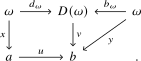 The square with horizontal maps \(x\) and \(v\) and vertical maps \(d_\omega\)
and \(u\) is a morphism in \(\Fun([1],A_{/X})\) mapping to the prescribed
morphism in \(A_{\bullet/X}\).
We claim that localization at \(K\) is the same as localization at \(\tilde W\). One inclusion follows from the preceding calculation: \(\tilde W\subseteq K\). Conversely, let \(h\) belong to \(K\), and write \(f=\ev_0(h)\). If the target of the square defining \(h\) lies over \((b,\gamma):A_{/X}\), then \(f\) may be viewed as a morphism in \(A_{/i(b)}\). Its image under \(\tau_{i(b)}\colon A_{/i(b)}\to i(b)\) is precisely the fiber component of \(q_X(h)\), hence is an isomorphism because \(q_X(h)\) is cocartesian. By Lemma 15.1.9, \(f\) becomes invertible after localizing \(A_{/i(b)}\) at its last vertex morphisms. The domain functor from \(A_{/i(b)}\), equivalently from the corresponding slice of \(A_{/X}\), to \(A_{/X}\) preserves last vertex morphisms. It follows that \(f\) becomes invertible in \((A_{/X})[W^{-1}]\). The first equivalence of this lemma now shows that \(h\) becomes invertible in \(\Fun([1],A_{/X})[\tilde W^{-1}]\). Thus every member of \(K\) is already inverted by localization at \(\tilde W\).
The two universal properties therefore identify the localizations at \(K\) and at \(\tilde W\). Consequently, the composite \(j_Xq_X\) gives \[ \Fun([1],A_{/X})[\tilde W^{-1}] \iso A_{\bullet/X}[\mathrm{Cocart}^{-1}] \iso Li_!(X), \] as required.