Lemma 15.1.9. Let \(i\colon A\to\Cat\) be fully faithful and suppose that \((A,i)\) is equipped with a décalage structure. For every small category \(C\), the functor \[ \tau_C\colon A_{/C}\longrightarrow C \] exhibits \(C\) as the localization of \(A_{/C}\) at the morphisms whose image in \(A\) is a last vertex morphism.
Proof
By Proposition 15.1.7, the functor \(\tau_C\) is the localization at the family \(V\) of morphisms that it sends to identities. It sends every last vertex morphism to an isomorphism. It therefore suffices to show that every member of \(V\) becomes invertible after localizing at the last vertex morphisms.
Let \(u\) be a morphism in \(A_{/C}\) that is sent to an identity by \(\tau_C\).
Its data can be displayed as
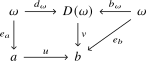 together with a functor \(\gamma\colon i(b)\to C\). The assumption on
\(\tau_C(u)\) says that \(\gamma i(v)\colon[1]\to C\) is constant. Consequently,
all the arrows in the displayed diagram define morphisms in \(A_{/C}\) with
the indicated constant labels where appropriate. The morphisms \(e_a\), \(e_b\),
and \(b_\omega\) are last vertex morphisms.
Since \(i\) is fully faithful and \(i(\omega)=[0]\), the object \(\omega\) is terminal in \(A\). Let \(p\colon D(\omega)\to\omega\) be the unique morphism. For the constant labels just described, it defines a morphism in \(A_{/C}\) and satisfies \[ p b_\omega=\id_\omega=p d_\omega. \] After inverting \(b_\omega\), the first equality identifies \(p\) with \(b_\omega^{-1}\), and the second then identifies \(d_\omega\) with \(b_\omega\). Thus \(d_\omega\) is invertible. The relations \[ v b_\omega=e_b \qquad\text{and}\qquad v d_\omega=u e_a \] now show successively that \(v\) and \(u\) are invertible. Hence every member of \(V\) is inverted by the localization at last vertex morphisms. The universal property of the localization at \(V\) now proves the claim.