Corollary 15.2.13. A morphism of univalent Segal animae is an equivalence if and only if it is a Dwyer–Kan equivalence.
Proof
An equivalence is fully faithful and essentially surjective, so the condition
is necessary.
Let \(f\colon C\to D\) be a Dwyer–Kan equivalence
between univalent Segal animae.
By virtue of Proposition 15.2.12,
it suffices to prove that \(f_0\colon C_0\to D_0\) is an equivalence.
It suffices to check that \(f_0\) is both a cover and an embedding
(see Proposition 11.2.10).
We consider the following commutative diagram.
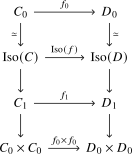 The upper square is cartesian because its two vertical maps are equivalences
(since \(C\) and \(D\) are univalent). The lower square is cartesian because \(f\)
is fully faithful.
The middle square is a pullback square as well by Lemma 15.2.11.
Therefore, the outer square is cartesian, which proves that \(f_0\) is an embedding.
It remains to show that \(f_0\) is a cover. Let
\[
P:=C_0\times_{f_0,D_0,s}\Iso(D),
\]
where \(s\colon\Iso(D)\to D_0\) sends an isomorphism to its source. Thus an object
of \(P\) is a pair \((x,u)\) consisting of an object \(x : C_0\) and an isomorphism
\(u\colon f(x)\iso y\) in \(D\). We have a triangle
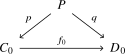 with \(p(x,u)=x\) and \(q(x,u)=y\). Since \(D\) is univalent, its source and target
maps \(s,t\colon\Iso(D)\to D_0\) are both inverse to the equivalence
\(\id\colon D_0\to\Iso(D)\), and are therefore isomorphic. Consequently,
\(q = f_0p\). The map \(q\) is a cover by the essential surjectivity of \(f\),
so \(f_0p\) is a cover as well. It follows from the cancellation property of covers,
Corollary 11.2.7, that \(f_0\) is a cover. Hence \(f_0\) is an
equivalence by Proposition 11.2.10, which finishes
the proof by Proposition 15.2.12.