Theorem 16.2.5 (Rezk, Sattler–Wärn). A small category \(A\) is confluent if and only if the colimit functor \[ \colim_A\colon\Fun(A,\An)\to\An \] commutes with pullbacks.
Proof
Assume that \(A\) is confluent. Under the unstraightening equivalence
\[
\Un\colon\Fun(A,\An)\iso\LFib(A)\, ,
\]
the colimit functor \(\colim_A\) corresponds to the functor
\[
\LFib(A)\to\An
\]
defined by assigning to each left fibration \(p\colon X\to A\)
the anima \(\Pi_{\infty}(X)\).
In other words, it suffices to prove that, for any pullback square of
small categories of the form
 in which all functors are left fibrations, and such that there is a left
fibration \(p\colon Y\to A\), the induced commutative square
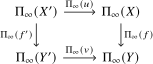 is a pullback square. In order to prove this, we start by
observing that, by virtue of Proposition 16.2.4,
\(Y\) itself is confluent.
For each morphism \(w\colon y_0\to y_1\) in \(Y\), the induced functor
\[
w^*\colon Y_{y_1/}\to Y_{y_0/}
\]
is thus terminal. Since \(f\) is a left fibration, it is in particular proper.
Therefore, the pullback squares
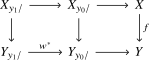 show that \(w^*\) induces a terminal functor \(X_{y_1/}\to X_{y_0/}\).
Since terminal functors are weak homotopy equivalences, the
equivalence of properties (i) and (iii) in Quillen’s Theorem B (Theorem 13.4.5)
implies that we have a canonical equivalence
\[
\Pi_{\infty}(X')\iso \Pi_{\infty}(Y')\times_{\Pi_{\infty}(Y)}\Pi_{\infty}(X)\, ,
\]
which proves that the functor \(\colim_A\) preserves pullbacks of animae.
Conversely, let us assume that the functor
\(\colim_A\) preserves pullbacks in \(\An\).
Observe that, for any pullback square of the form
 if we see \(\Pi_{\infty}(X)\) as an object of \(\An\), we have a canonical equivalence
\[
\colim_A F=\Pi_{\infty}(X)
\]
in \(\An\). Given two morphisms \(u\colon x\to y\) and \(v\colon x\to z\) in \(A\),
we thus have
\[
\colim_{a : A}(\Hom_A(y,a)\times_{\Hom_A(x,a)}\Hom_A(z,a))=\Pi_{\infty}(A_{y/}\times_{A_{x/}}A_{z/})\, .
\]
Similarly we have:
\[
\colim_{a : A}\Hom_A(y,a)\times_{\colim_{a : A}\Hom_A(x,a)}\colim_{a : A}\Hom_A(z,a)
=\Pi_{\infty}(A_{y/})\times_{\Pi_{\infty}(A_{x/})}\Pi_{\infty}(A_{z/})
\]
and since any category with an initial object is weakly contractible,
this yields
\[
\colim_{a : A}\Hom_A(y,a)\times_{\colim_{a : A}\Hom_A(x,a)}\colim_{a : A}\Hom_A(z,a)=e
\]
where \(e\) is the terminal anima. The property that \(\colim_A\) commutes with pullbacks of animae
thus implies that
\[
\Pi_{\infty}(A_{y/}\times_{A_{x/}}A_{z/})=e\, .
\]
As explained in Remark 16.2.2, this proves that \(A\) is confluent.