Proposition 10.4.6 (Cosiftedness of simplex category). The diagonal functor \(\delta\colon \simp \to \simp \times \simp, [n] \mapsto ([n],[n])\) is an initial functor.
Proof
Let \(m,n \in \N\) be two natural numbers. By Corollary 9.5.7, we have to show that the slice category
\[
\simp_{/([m],[n])} = \simp \times_{\simp \times \simp} (\simp \times \simp)_{/([m],[n])}
\]
is weakly contractible. The forgetful functor \(\simp_{/([m],[n])} \to \simp\) is a right fibration, hence there exists a pullback square
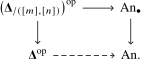 The classifying presheaf of this right fibration has value at \([p]\) equal to
\[
\Hom_\simp([p],[m])\times\Hom_\simp([p],[n]).
\]
It is therefore the product \(\simp^m\times\simp^n\) of the presheaves
represented by \([m]\) and \([n]\).
Since \(- \star [0] \colon \Cat \to \Cat\) preserves simplices by definition, it restricts to an endofunctor on \(\simp\), hence we may consider the maps \[ \id_{\simp} \to (-) \star [0] \leftarrow \const_{[0]} \] of endofunctors of \(\simp\).
Now consider the product \([m] \times [n]\) in \(\Cat\). The simplicial presheaf
\([p]\mapsto\Map([p],[m]\times[n])\) is canonically the product
\(\simp^m\times\simp^n\). The inclusion
\[
[m] \times [n] \hookrightarrow ([m] \times [n]) \star [0]
\]
admits a right adjoint
\[
r\colon ([m] \times [n]) \star [0] \to [m] \times [n]
\]
satisfying \(r(a,b) = (a,b)\) for \((a,b) \in [m] \times [n]\) and \(r(0) = (m,n)\). Thus, given a functor \((a,b)\colon [p]\to [m]\times[n]\), we may consider
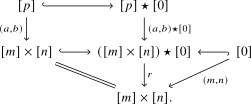 This provides homotopies between \(\id_{\simp_{/([m],[n])}}\) and \(\varphi\), and between \(\varphi\) and \(\const_{(m,n)}\), where
\[
\varphi([p], (a,b)) = ([p+1], r\circ((a,b)\star\id_{[0]})).
\]
It follows that \(\simp_{/([m],[n])}\) is weakly contractible.