Corollary 13.4.3. Let \(A\) be a small category and \(X,Y\colon A\to \Cat\) be two functors and \(u\colon X\to Y\) a natural transformation. We assume that the following two conditions are satisfied.
(i) For each object \(a : A^\simeq\), the induced functor \(u_a\colon X_a\to Y_a\) is a cocartesian fibration (a cartesian fibration, a right fibration, or a left fibration).
(ii) For each morphism \(\alpha\colon a_0\to a_1\) in \(A\), the induced commutative square
 is a pullback square in \(\Cat\).
Then the induced functor \(\colim_{a : A} X_a\to \colim_{a : A} Y_a\)
is a cocartesian fibration
(a cartesian fibration, a right fibration, a left fibration, respectively)
and the canonical commutative squares
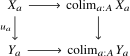 are pullback squares for any object \(a : A^\simeq\).
Proof
Let us discuss the case of cocartesian fibrations. The natural transformation \(u\) can be interpreted as an \(A\)-indexed diagram with values in \(\Fun^{\mathrm{coCart}}_{\Cart}([1],\Cat)\). Taking the colimit there and the preceding theorem yields the conclusions of the corollary.
Assuming that all functors \(u_a\) are left fibrations, since there is a full embedding
\[
\Fun(A,\An)\hookrightarrow\Fun(A,\Cat)
\]
whose essential image consists of those functors taking values
in \(\An\) object-wise, we can see the natural transformation from \(Y\) to the
constant \(A\)-indexed functor with value \(\Cat\)
classifying the left fibrations \(u_a\) as natural transformation from \(Y\) to
the constant functor with value \(\An\). In other words, we get a commutative diagram of the form
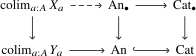 in which all squares are pullback squares, proving that the functor induced on colimits
is a left fibration.
The remaining cases of cartesian fibrations and of right fibrations are proved similarly by duality, or by applying the preceding cases to the diagram induced by composing with the equivalence \((-)\catop\), and then applying \((-)\catop\) again, using that the latter preserves both pullbacks and colimits.