Proposition 3.4.4. The following conditions are equivalent:
(1) For every category \(C\), the category \(\geom{C}\) is a groupoid;
(2) The geometric realization \(\geom{[1]}\) of the walking morphism \([1]\) is contractible;
(3) For every category \(C\), the functor \(p_{[1]}^* \colon C \to \Fun([1],C)\) is a full subcategory of \(\Fun([1],C)\) (in the sense of Definition 3.2.2);
(4) For every category \(C\), the functor \(\pi_{\Iso}\colon \Iso(C) \to \Fun([1],C)\) is a full subcategory;
(5) Every category \(C\) for which the map \(C^{\simeq} \simeq \Map(*,C) \xrightarrow{p_{[1]}^*} \Map([1],C)\) is an equivalence is a groupoid;
(6) For every category \(C\), the subcategory \(\lra{\Iso(C)^{\simeq}}_C \subseteq C\) spanned by all the isomorphisms in \(C\) is a groupoid;
(7) For every category \(C\), the inclusion \(C^{\simeq} \hookrightarrow C\) induces an equivalence \(C^{\simeq} \iso \lra{\Iso(C)^{\simeq}}_C\) between the groupoid core of \(C\) and the subcategory of \(C\) spanned by all its isomorphisms.
Proof
We start by showing that (1) implies (2). By (1), the category \(\geom{[1]}\) is a groupoid, so it suffices by Proposition 1.4.11 to show that for every groupoid \(\Gamma\) the induced map \[ \Map(*,\Gamma) \to \Map(\geom{[1]},\Gamma) \] is an equivalence. By Lemma 3.4.3, this map corresponds under the canonical equivalences to the map \[ p_{[1]}^*\colon \Gamma \to \Map([1],\Gamma). \] But this map is an equivalence since \(\Gamma\) is a groupoid, finishing the proof.
For (2) \(\implies\) (3), the equivalence \(\geom{[1]}\iso *\) and the universal property of geometric realization show that precomposition with \(p_{[1]}\colon[1]\to *\) induces an equivalence \[ C \iso \Fun^{\Map([1],[1])}([1],C), \] where the right-hand side is a full subcategory of \(\Fun([1],C)\) by construction. Thus \(p_{[1]}^*\) exhibits \(C\) as that full subcategory.
The Rezk equivalence \(C\iso\Iso(C)\) identifies \(p_{[1]}^*\) with the composite \(C\to\Iso(C)\xrightarrow{\pi_{\Iso}}\Fun([1],C)\). Hence (3) and (4) are equivalent.
For (3) \(\implies\) (5), recall that \(C\) is a groupoid if and only if the map \(C \to \Fun([1],C)\) is an equivalence. Since this functor is a full subcategory by (3), it follows from Lemma 3.2.12 that we may check this on objects, giving the criterion from (5).
We will now deduce (6) from (5). To show \(\lra{\Iso(C)^{\simeq}}_C\) is a groupoid, it suffices by (5) to show that the map \((\lra{\Iso(C)^{\simeq}}_C)^{\simeq} \to \Map([1],\lra{\Iso(C)^{\simeq}}_C)\) is an equivalence. To this end, consider the following commutative diagram, where the two horizontal maps are induced by the inclusion \(i\colon \lra{\Iso(C)^{\simeq}}_C \hookrightarrow C\):
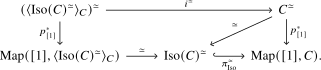 By the 2-out-of-3 property it remains to show that the top map is an equivalence. To construct an inverse, we consider the inclusion \(\imath_C\colon C^{\simeq} \to C\). It sends all morphisms to isomorphisms, so induces a functor \(C^{\simeq} \to \lra{\Iso(C)^{\simeq}}_C\). Since the source is a groupoid, it factors through a map \(\varphi\colon C^{\simeq} \to (\lra{\Iso(C)^{\simeq}}_C)^{\simeq}\). To check the relations \(\varphi \circ i^{\simeq} = \id\) and \(i^{\simeq} \circ \varphi = \id\), we may do so after composing with the embedding \(\imath_C\colon C^{\simeq} \hookrightarrow C\) from Corollary 2.5.3 and the embeddings \((\lra{\Iso(C)^{\simeq}}_C)^{\simeq} \hookrightarrow \lra{\Iso(C)^{\simeq}}_C\) and \(\lra{\Iso(C)^{\simeq}}_C \hookrightarrow C\) (Lemma 3.1.5) after which the claim becomes a tautology. This establishes (6).
Assume (6). The functor \(C^{\simeq} \to \lra{\Iso(C)^{\simeq}}_C\) constructed above is then a functor between groupoids. Its map on groupoid cores is inverse to the equivalence \(i^{\simeq}\) constructed in the preceding paragraph. Since the groupoid-core inclusions of its source and target are equivalences by Axiom G and Proposition 1.4.15, the functor itself is an equivalence by 2-out-of-3. This proves (7).
Finally, we show that (7) implies (1). The localization functor \(\lambda_C\colon C \to \geom{C}\) sends all morphisms of \(C\) to isomorphisms, hence it factors through the subcategory of \(\geom{C}\) spanned by its isomorphisms. By (7) this subcategory is equivalent to the groupoid core of \(\geom{C}\). The resulting functor \(C \to \geom{C}^{\simeq}\) still inverts all morphisms in \(C\), hence induces a functor \(\geom{C} \to \geom{C}^{\simeq}\). By uniqueness of the localization factorization, the composite \(\geom{C} \to \geom{C}^{\simeq} \hookrightarrow \geom{C}\) is identified with the identity. Thus the embedding \(\geom{C}^{\simeq} \hookrightarrow \geom{C}\) admits a section and is an equivalence by Lemma 1.6.24. It follows that \(\geom{C}\) is a groupoid.