Proposition 18.7.3. Given a small category with finite colimits \(C\) and a pointed right exact category \(D\), pre-composing with the canonical right exact functor \(C\to C_\bullet\) induces an equivalence of the form \[ \Rex(C_\bullet,D)\simeq\Rex(C,D)\, . \] In particular, the full embedding \(\RexCat_\bullet\hookrightarrow\RexCat\) has a left adjoint \[ C\mapsto C_\bullet\, . \]
Proof
It suffices to prove that, for any category \(A\), we have an equivalence of the form \[ \Map(A,\Rex(C_\bullet,D))\simeq\Map(A,\Rex(C,D))\, . \] Using the identification \[ \Map(A,\Rex(C,D))=\Rex(C,\Fun(A,D))^\simeq\, , \] we see that it suffices to prove that we get an equivalence of the form: \[ \Rex(C_\bullet,D)^\simeq\simeq\Rex(C,D)^\simeq\, . \] In other words, it suffices to prove the last assertion of the proposition.
We may assume that \(D\) is small (up to enlarging the ambient universe).
Since \(D\) is also pointed, we observe that the canonical right exact functor
from \(D\) to \(D_\bullet\) is an equivalence. Indeed, there is an
equivalence
\[
\Lex(D\catop,\An_\bullet)\simeq\Lex(D\catop,\An)
\]
due to the fact that the Yoneda embedding is exact, hence sends the initial object of \(D\)
to an object \(*\) that is both initial and terminal, which allows us to use
the canonical identification
\[
\Lex(D\catop,\An)_{*/}=\Lex(D\catop,\An_\bullet)\, .
\]
This implies that the canonical functor \(D\to D_\bullet\) is fully faithful
(being the restriction of an equivalence of categories). On the other hand, we know that its essential
image is stable under finite colimits and contains the image of any object of \(D\), which
proves the essential surjectivity, by definition of \(D_\bullet\).
Any right exact functor \(f\colon C\to D\) extends to small colimit preserving functors
\[
f_!\colon\Lex(C\catop,\An)\to\Lex(D\catop,\An)\ \text{and}\
f_!\colon\Lex(C\catop,\An_\bullet)\to\Lex(D\catop,\An_\bullet)
\]
by Corollary 18.6.6. Since the functor \(x\mapsto x_+\)
commutes with colimits, we have a commutative square of the form
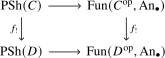 by Corollary 13.1.10
and this restricts to a commutative square of the form
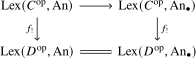 through an easy application of Theorem 18.2.8.
By definition of \(C_\bullet\), this induces a commutative square of the form
 This shows that the map
\[
\Rex(C_\bullet,D)^\simeq\to\Rex(C,D)^\simeq
\]
has a section. We will now prove that
this is an embedding. Observe first that,
by virtue of Theorem 18.2.10, the factorization of \(f\)
through \(C_\bullet\) is totally determined by the factorization of
\[
f_!\colon \Lex(C\catop,\An)\to \Lex(D\catop,\An)=\Lex(D\catop,\An_\bullet)
\]
through \(\Lex(C\catop,\An_\bullet)\).
The right adjoint of the latter is the composition of
the functor
\[
f^*\colon\Lex(D\catop,\An)=\Lex(D\catop,\An_\bullet)\to \Lex(C\catop,\An_\bullet)
\]
with the forgetful functor
\[
\Lex(C\catop,\An_\bullet)\to\Lex(C\catop,\An)\, .
\]
The uniqueness of left adjoints and the compatibility of the formation of adjoints with respect to
composition shows that the factorization through \(\Lex(C\catop,\An_\bullet)\) is unique.
This implies that the factorization of \(f\) through \(C_\bullet\) is unique.