Lemma 6.5.16. Let
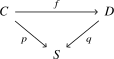 be a commutative triangle such that \(p\) and \(q\) are cartesian (resp. cocartesian) fibrations and \(f\) is a cartesian (resp. cocartesian) functor over \(S\). If the induced functor \(f_s\colon C_s\to D_s\) is fully faithful for every object \(s\) of \(S\), then \(f\) is fully faithful.
Proof
We treat the cartesian case; the cocartesian case is dual. Let \(x_0\) and \(x_1\) be objects of \(C\), and write \(s_i=p(x_i)\). The induced map \[ C(x_0,x_1) \longrightarrow D(f(x_0),f(x_1)) \] is a map of animae over \(S(s_0,s_1)\). We show that it is an equivalence on every fiber. Fix a morphism \(w\colon s_0\to s_1\) and choose a \(p\)-cartesian lift \[ \widetilde{w}\colon w^*x_1\to x_1. \] Since \(f\) is a cartesian functor, \(f(\widetilde{w})\) is a \(q\)-cartesian lift of \(w\). The universal properties of these cartesian lifts give equivalences \[ C(x_0,x_1)_w \simeq C_{s_0}(x_0,w^*x_1) \] and \[ D(f(x_0),f(x_1))_w \simeq D_{s_0}(f(x_0),f(w^*x_1)). \] Under these equivalences, the map on fibers is induced by \(f_{s_0}\) and is therefore an equivalence by hypothesis. Thus the map on hom animae is an equivalence, and \(f\) is fully faithful.
From Section 6.5, Pointwise and fiberwise criteria for fibrations.