Definition 2.1.3 (Arrow category/hom anima). For a category \(C\), we define its arrow category as
\[
\Ar(C) \quad := \quad \Fun([1],C).
\]
Given absolute objects \(x\) and \(y\) of \(C\), we define the hom anima \(C(x,y)\) via the following pullback square:
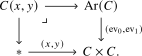 At this point, the pullback defines a category. We call it the hom anima in anticipation of
Corollary 4.3.5, where it will be shown to be an anima.
Observe that the absolute objects of \(C(x,y)\) are triples \((f,\alpha,\beta)\), where \(f\colon x' \to y'\) is a morphism in \(C\) and \(\alpha\colon x = x'\) and \(\beta\colon y = y'\) are identifications in \(C\). We will sometimes use the alternative notation \(\Hom_C(x,y)\) for \(C(x,y)\).