Construction 2.3.4. We construct a functor \(i\colon C \to \Iso(C)\) lifting the functor \(1\colon C \to \Ar(C)\) given by \(x \mapsto \id_x\). Informally, \(i\) sends \(x\) to the following commutative diagram in \(C\):
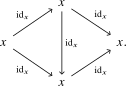 More formally, restriction along the map \(p_{[2]}\colon [2] \to [0]\) induces a functor \(p_{[2]}^*\colon C \to \Triang(C)\), giving a functor \((p_{[2]}^*,p_{[2]}^*)\colon C \to \Triang(C) \times_{\Ar(C)} \Triang(C)\). Since the two relevant edges of this diagram are both the identity on \(x\), this functor factors through \(\Iso(C)\), providing the desired functor \(i\colon C \to \Iso(C)\).