Definition 7.1.1. Let \(I\) and \(C\) be categories. We refer to objects of the functor category \(\Fun(I,C)\) as \(I\)-indexed diagrams in \(C\). Given such a diagram \(F \in \Fun(I,C)\), we define the category \(C_{/F}\) of cones over \(F\) as the following relative slice category:
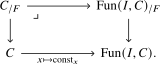 In other words, a cone over \(F\) consists of a pair \((x,\varepsilon)\) where \(x \in C\) and \(\varepsilon\colon \const_x \to F\) is a natural transformation. A cone \((x,\varepsilon)\) over \(F\) is called a limit cone if it is a terminal object of the cone category \(C_{/F}\). If it exists, a limit cone is unique. The underlying object \(x\) will then be called the limit of \(F\) and denoted by \(\lim(F)\), or \(\lim_I F\), or \(\lim_{i \in I} F(i)\).
Dually, we define a cocone under \(F\) to be an object of the dually defined category \(C_{F/}\). A colimit cocone is an initial object of \(C_{F/}\), and its underlying object, if it exists, will be denoted by \(\colim(F)\), or \(\colim_I F\) or \(\colim_{i \in I} F(i)\).