Proposition 12.2.4. The fibers of both projections \(s\colon \Tw(C) \to C\catop\) and \(t\colon \Tw(C) \to C\) have initial objects.
Proof
We have a commutative diagram
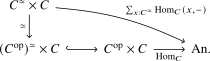 So we obtain pullback squares
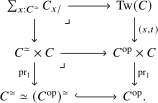 In particular, the fiber of \(s\) over an object \(x \in C\catop\) is the slice category \(C_{x/}\), which has an initial object \((x,\id_x)\).
Now consider an object \(y\) of \(C\) and let \(\Tw(C)_y\) denote the fiber of \(t\colon \Tw(C) \to C\) at \(y\):
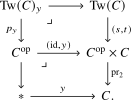 Note that \(p_y\) is a left fibration whose fiber at \(y\) is given by \(C\catop(y,y) \iso C(y,y)\), hence we obtain an object \((y,\id_y)\) in this fiber, producing an object \(\id_y \in \Tw(C)_y\). We then obtain a unique map
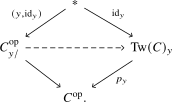 It will thus suffice to show that for every object \(x\) of \(C\catop\) (i.e. every object \(x\) of \(C\)) the dashed map induces an equivalence
\[
C\catop(y,x) \iso C(x,y).
\]
Under the isomorphism from Lemma 12.1.12, we have to check in fact that the dashed
map induces the identity of \(C(x,y)\). A term \(f\) in \(C(x,y)\) corresponds to a functor
\[
f\colon [1]\to C\, .
\]
By functoriality of the formation of the twisted arrow category
(Proposition 12.2.3),
we obtain a commutative square below.
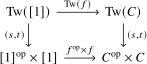 Since \(f\) sends the ordered pair \(0,1\) to \(x,y\), this induces a commutative diagram of the form
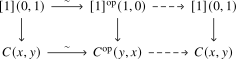 in which the vertical maps are induced by \(f\catop\) and \(f\).
All the maps of the upper horizontal line are isomorphisms because they are maps between terminal objects
(expressing that \(1\) is terminal in \([1]\), say).
Interpreting this proof in context \(C(x,y)\) for \(f\) the universal term of \(C(x,y)\),
this proves that the dashed map is indeed fiber-wise the identity.