Proposition 1.4.8 (Coherence of composition). Composition in mapping animae has specified left and right unitors and an associator. These satisfy the triangle and pentagon identities through specified identifications.
Proof
Throughout the proof, we make use of the following notation: Given a ‘parameter anima’ \(P\) and a functor \(f\colon P\to\Map(C,D)\), we define \[ \widetilde{f} \; := \; (\pr_1,f^u) \colon P \times C \to P \times D. \] If \(g\colon P\to\Map(D,E)\) is any other functor, then there is an identification \[ \widetilde{g} \circ \widetilde{f} = \widetilde{g \circ f}; \] indeed, we may construct this identification componentwise, where it is clear for the first component and follows from the defining property of \(\mu_{C,D,E}\) in the second component. The compatibility with the primitive coherence identifications and change of parameter can likewise be checked after both projections, using Lemmas 1.3.16 and 1.4.6 and the coherence axioms for composition.
We now use this to construct the associator. Given a third functor \(h\colon P \to \Map(E,F)\), we obtain three composable functors \[ P\times C \xrightarrow{\widetilde{f}} P\times D \xrightarrow{\widetilde{g}} P\times E \xrightarrow{\widetilde{h}} P\times F. \] Using the primitive associator and the previous comparisons, we get identifications \begin{align*} \widetilde{(h \circ g) \circ f} &= \widetilde{h \circ g} \circ \widetilde{f} = (\widetilde{h} \circ \widetilde{g}) \circ \widetilde{f} = \widetilde{h} \circ (\widetilde{g} \circ \widetilde{f}) = \widetilde{h} \circ \widetilde{g \circ f} = \widetilde{h \circ (g \circ f)}. \end{align*} Passing to the second component of this identification, we obtain an identification between the uncurrying of \((h\circ g)\circ f\) and that of \(h\circ(g\circ f)\); we may then use the mapping-anima axiom to lift this to the desired associator.
For the unitors, note that the constant functor \(\const_{\id_C}\colon P \to \Map(C,C)\) corresponds under (un)currying to the projection functor \(\pr_2\colon P \times C \to C\), and so the associated functor \(\widetilde{\const_{\id_C}}\colon P \times C \to P \times C\) is identified with the identity. We then consider the unitors \(\lambda_{\widetilde{f}} : \id_{P \times D} \circ \widetilde{f} = \widetilde{f}\) and \(\rho_{\widetilde{f}} : \widetilde{f} \circ \id_{P \times C} = \widetilde{f}\), and with the same arguments as above deduce the desired relations \(\id_D \circ f = f\) and \(f \circ \id_C = f\).
Observe that both of these constructions are compatible with substitution in the parameter anima \(P\):
given a map of animae \(\sigma\colon Q \to P\), we can construct identifications
\[
\alpha^P_{h,g,f} \star \sigma = \alpha^Q_{h\sigma,g\sigma,f\sigma}, \qquad \lambda_f^P \star \sigma = \lambda_{f\sigma}^Q, \qquad \rho_f^P \star \sigma = \rho_{f \sigma}^Q,
\]
up to the substitution comparisons relating e.g. \(((h \circ g) \circ f)\sigma\) to \(((h \sigma) \circ (g \sigma)) \circ f\sigma\). To see this, note that by Lemma 1.4.6 there is a commutative square
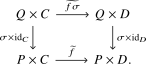 Using this for \(f\), \(g\) and \(h\) and applying the interchange law and the various primitive coherence identities, we get the relation on associators after uncurrying, which suffices to establish the relation. The analogous argument applies to the unitors.
For the pentagon, assume given a fourth map \(k\colon P \to \Map(F,G)\), and consider the primitive pentagon identification for the four functors \[ P\times C \xrightarrow{\widetilde{f}} P\times D \xrightarrow{\widetilde{g}} P\times E \xrightarrow{\widetilde{h}} P\times F \xrightarrow{\widetilde{k}} P \times G. \] For each of the five vertices of the resulting pentagon, we may use iterated identifications of the form \(\widetilde{g} \circ \widetilde{f} = \widetilde{g \circ f}\) to put them into the form \(\widetilde{u}\) for some \(u\). By the construction of the associator, the substitution compatibility, and interchange, projecting the five edges of the resulting pentagon to the second component identifies them with the uncurryings of the five edges of the desired pentagon. The primitive pentagon identification therefore gives an identification between the uncurryings of the two composites around this pentagon. The mapping-anima axiom then provides the desired pentagon identification.
The triangle identification is obtained by similar means.