Lemma 17.1.12. Let \(W\hookrightarrow C\) be a subcategory closed under pullbacks and with the \(2\)-out-of-\(3\) property.
Given two objects \(x\) and \(y\) in \(C\) and two diagrams of the form
\[
x\xleftarrow{s}z\xrightarrow{p}y\quad\text{and}\quad
x\xleftarrow{s'}z'\xrightarrow{p'}y
\]
with \(s\) and \(s'\) in \(W\), the anima \(\gamma(s)^{-1}\circ\gamma(p)=\gamma(s')^{-1}\circ\gamma(p')\)
is covered by the collection of commutative diagrams in \(C\) of the form
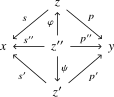 with \(s''\) in \(W\).
In particular, the collection of morphisms of the form \(f\colon x\to y\) in \(C\) inducing an isomorphism in \(L(C)\) is covered by the collection of diagrams of the form \[ x''\xrightarrow{p'}x'\xrightarrow{p}x\xrightarrow{f}y \] with the property that each composite \(f\circ p\) and \(p\circ p'\) is in \(W\).
Proof
We observe that \(W(x)_{/y}\) always has pullbacks (for any objects \(x\) and \(y\)) and thus that the localization \(\Pi_{\infty}(W(x)_{/y})\) is obtained by a right calculus of fractions at any object of \(W(x)_{/y}\). This implies the first assertion right away. The last assertion follows from the first by interpreting the fact that a map in \(L(C)\) is invertible if and only if it has a right inverse which itself has a right inverse.