Theorem 17.1.5. Let \(C\) be a category and \(W\hookrightarrow C\) a subcategory. We denote by \(\gamma\colon C\to L(C)\) the localization of \(C\) by \(W\). We assume that the category \(C\) has pullbacks and that the subcategory \(W\) is closed under pullbacks and has the \(2\)-out-of-\(3\) property. Then the following properties hold.
(i) For any object \(x\) of \(C\), the full subcategory \(W(x)\) of \(C_{/x}\) spanned by pairs \((y,f)\) such that \(f\colon y\to x\) is a morphism in \(W\) is a right calculus of fractions at \(x\).
(ii) For any object \(x\) of \(C\), the category \(W(x)\catop\) is filtered.
(iii) The category \(L(C)\) has pullbacks and the functor \(\gamma\) commutes with pullbacks.
(iv) Given any category \(D\) with pullbacks and any functor \(f\colon C\to D\) sending any map in \(W\) to an isomorphism in \(D\), the induced functor \(\bar{f}\colon L(C)\to D\) commutes with pullbacks if and only if the functor \(f\) itself has the same property.
(v) For any object \(x\) of \(C\), the functor \(\gamma\) induces a functor \[ \gamma_{/x}\colon C_{/x}\to L(C)_{/\gamma(x)} \] that exhibits \(L(C)_{/\gamma(x)}\) as the localization of \(C_{/x}\) at the subcategory \(W(x)\hookrightarrow C_{/x}\).
Proof
Property (i) is a particular case of Proposition 17.1.3. Let \(x\) be an object of \(C\). We check immediately that the collection of objects in \(W(x)\) is stable under pullbacks in \(C_{/x}\). Therefore, \(W(x)\) has pullbacks, which implies right away that \(W(x)\catop\) is confluent (see Example 16.2.3). But \(W(x)\catop\) has an initial object, hence is weakly contractible, which shows property (ii).
In order to establish (iii), we want to prove that, for each pair of morphisms
\[
x\xrightarrow{\ f \ }y\xleftarrow{\ v \ } y'
\]
in \(L(C)\), there exists a pullback square in \(L(C)\) of the form
 in \(L(C)\). It suffices to prove such a statement in context
\[
\Gamma=\sum_{x,y,y' : L(C)^\simeq}L(C)(x,y)\times L(C)(y',y)
\]
for the universal term \(\gamma : \Gamma\) (in context \(\Gamma\)).
Since
\[
\gamma^\simeq\colon C^\simeq\to L(C)^\simeq
\]
is a cover by Corollary 11.2.16, so is
\[
\gamma^\simeq\times\gamma^\simeq\times\gamma^\simeq\colon C^\simeq\times C^\simeq\times C^\simeq\to
L(C)^\simeq\times L(C)^\simeq\times L(C)^\simeq\, .
\]
We thus have a cover
\[
\sum_{x,y,y' : C^\simeq}L(C)(\gamma(x),\gamma(y))\times L(C)(\gamma(y'),\gamma(y))
\to\Gamma\, .
\]
In other words, it suffices to prove the existence of pullbacks in the case where
all objects \(x,y,y'\) come from \(C\). Furthermore, for all objects \(x\) and \(y\) in \(C\),
by virtue of Corollary 11.2.16,
we have a cover of the form
\[
(W(x)_{/y})^\simeq\to\Pi_\infty(W(x)_{/y})=L(C)(\gamma(x),\gamma(y))\, .
\]
This yields a cover
\[
\sum_{x,y,y' : C^\simeq} (W(x)_{/y})^\simeq\times (W(y')_{/y})^\simeq
\to\Gamma\, .
\]
This means that it suffices to prove that the formation of pullbacks
from diagrams as above is possible in \(L(C)\) in the case where \(f\) and \(v\) are of the form
\[
f=\gamma(s)^{-1}\circ\gamma(p)\quad\text{and}\quad
v=\gamma(t)^{-1}\circ \gamma(q)\quad\text{respectively,}
\]
with \(p\colon x_0\to y\) and \(q\colon y'_0\to y\) any maps in \(C\),
and \(s\colon x_0\to x\) and \(t\colon y'_0\to y'\) any maps in \(W\).
Therefore, it suffices to check that any pullback square in \(C\) of the form
in \(C\) yields a pullback square of the form
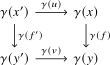 in \(L(C)\). For this, it suffices to prove that, given any object \(t\) in \(L(C)\), we have a
pullback square of the form
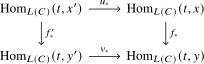 in \(\An\). It suffices to prove this for the universal term \(t\) in context \(L(C)^\simeq\).
Using the cover \(C^\simeq\to L(C)^\simeq\), we may assume, without loss of generality, that \(t\)
comes from \(C\). In other words, in order to prove property (iii), it suffices to prove that
any functor of type \( C\to\An\) given by the rule
\[
x\mapsto\Hom_{L(C)}(t,x)
\]
commutes with pullbacks for any \(t : C^\simeq\). But property (i) ensures that such a functor can be computed through the rule of the form
\[
x\mapsto\underset{w : W(t)\catop}{\colim}\Hom_C(z_w\catop,x)\, .
\]
Since each functor \(\Hom_C(z_w,-)\) commutes with pullbacks, and since \(W(t)\catop\)
is filtered, we see that, for any finite category \(A\) and any \(A\)-indexed functor with values in \(C\)
\[
a\mapsto x_a
\]
the canonical map
\[
\underset{w : W(t)\catop}{\colim}\Hom_C(z_w\catop,\underset{a : A}{\lim}x_a)=
\underset{w : W(t)\catop}{\colim}\underset{a : A}{\lim}\Hom_C(z_w\catop,x_a)\to
\underset{a : A}{\lim}\underset{w : W(t)\catop}{\colim}\Hom_C(z_w\catop,x_a)
\]
is an equivalence, by Theorem 16.2.9
and Proposition 16.4.13.
The proof of property (iv) is similar. First, if \(\bar f\) preserves pullback squares, since \(\gamma\) preserves pullback squares as well, so does the composite \(f=\bar f\circ \gamma\). Conversely, assuming that \(f\) preserves pullbacks, if \(\Gamma\) denotes the collection of all pullback squares in \(L(C)\), it suffices to prove that the pullback square in \(L(C)\) corresponding to the universal term of \(\Gamma\) yields a pullback square in \(D\) in context \(\Gamma\). Since, by right calculus of fractions, as seen in the proof of property (iii), the collection of pullback squares in \(C\) covers \(\Gamma\), it suffices to prove that the functor \(\bar f\) sends the image of any pullback square of \(C\) to a pullback square of \(D\). Since \(\bar f\circ \gamma=f\), this amounts to the property that \(f\) preserves pullback squares.
Finally, let us prove property (v). We consider an object \(x : C^\simeq\) and we want to prove that
the induced functor
\[
\bar\gamma_{/x}\colon L(C_{/x})\to L(C)_{/\gamma(x)}
\]
is an equivalence. It suffices to check that the functor \(\bar\gamma_{/x}\) is fully faithful and induces a cover
\[
(\gamma_{/x})^\simeq\colon(C_{/x})^\simeq\to (L(C)_{/\gamma(x)})^\simeq\, .
\]
The latter property comes from the fact that there is a commutative diagram of the form
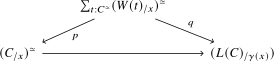 with \(p\) and \(q\) defined explicitly as follows. A term in the top vertex of the triangle above is a triple
of the form \(t\xleftarrow{s}z\xrightarrow{g} x\) in \(C\), with \(s\) in \(W\). The map \(p\) sends such a triple to the pair
\((z,g)\) whereas the map \(q\) sends it to \((t,\gamma(s)^{-1}\circ\gamma(g))\).
The commutativity of this triangle is provided by the identification in \(L(C)_{/\gamma(x)}\)
provided by the invertible morphism induced termwise by \(s\).
Therefore, in order to prove essential surjectivity,
it suffices to check that the map \(q\) is a cover, which follows right away from the fact that it
is the composition of the cover
\[
\sum_{t : C^\simeq}(W(t)_{/x})^\simeq\to \sum_{t : C^\simeq}L(C)(\gamma(t),\gamma(x))
\]
with the cover
\[
\sum_{t : C^\simeq}L(C)(\gamma(t),\gamma(x))\to
\sum_{t : L(C)^\simeq}L(C)(t,\gamma(x))\, .
\]
It remains to prove that, for any maps \(u\colon y\to x\) and \(v\colon z\to x\) in \(C\), the induced
map
\[
L(C_{/x})((y,u),(z,v))\to L(C)_{/\gamma(x)}((\gamma(y),\gamma(u)),(\gamma(z),\gamma(v)))
\]
is an equivalence. We observe that property (i) applies to \(C_{/x}\)
with respect to the full subcategory \(W(x)\hookrightarrow C_{/x}\).
We thus have a right calculus of fractions at \((y,u)\):
taking into account the identification of \(C_{/y}\) with the slice of \(C_{/x}\) over \((y,u)\),
we see that the collection of morphisms in \(L(C_{/x})\)
from \((y,u)\) to \((z,v)\) is thus the colimit
\[
\underset{w : W(y)\catop}{\colim}\Hom_{C_{/x}}((t_w,u_w)\catop,(z,v))\, ,
\]
where we see each term \(w : W(y)\) as a pair consisting of \(s_w\colon t_w\to y\) in \(W\)
and define \(u_w\colon t_w\to x\) as the composition of \(s_w\) and \(u\).
In other words, we can consider the diagram assigning to each term \(w\) in \(W(y)\catop\)
the diagram
\[
[0]\xrightarrow{u_w}\Hom_C(t_w,x)\xleftarrow{v_*}\Hom_C(t_w,z)\, .
\]
Forming first the pullback and then the \(W(y)\catop\)-indexed colimit yields
\(L(C_{/x})((y,u),(z,v))\), whereas, by right calculus of fractions at \(y\) in \(C\),
we see that taking the \(W(y)\catop\)-indexed colimit first and then
forming the pullback produces the collection of morphisms from \(\gamma(y)\) to
\(\gamma(z)\) over \(\gamma(x)\) in \(L(C)\).
Therefore, the property of fully faithfulness of the functor \(\bar\gamma_{/x}\) follows from property (ii)
and another application of Theorem 16.2.9.