Lemma 12.1.12. Let \(C\) be a category and let \(x,y : C^\simeq\) be two objects.
There is a preferred isomorphism
\[
C\catop(y,x)\iso C(x,y)\, .
\]
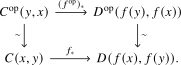
For every functor \(f\colon C\to D\), the following square commutes:
Proof
By definition, there is a canonical isomorphism \[ C\catop(y,x)\iso\Map_C(C_{y/},C_{x/})\, . \] On the other hand, since the fiber of the canonical projection \(C_{x/}\to C\) at \(y\) is \(C(x,y)\) by definition, Corollary 9.1.14 provides a canonical isomorphism \[ \Map_C(C_{y/},C_{x/})\iso C(x,y)\, . \] Composing these two isomorphisms gives the claimed identification, which sends a functor \(\alpha\colon C_{y/}\to C_{x/}\) over \(C\) to its value at \(\id_y\).
To prove the compatibility, work in the anima context \(C\catop(y,x)\) and let
\(\alpha\colon C_{y/}\to C_{x/}\) be the universal such functor. Applying the left Kan extension functor \(f_!\colon \Fun(C,\An) \to \Fun(D,\An)\) gives a map which under the identifications from Proposition 12.1.9 corresponds to the functor of left fibrations \(f_!\alpha\colon D_{f(y)/}\to D_{f(x)/}\). The functors \(f_{x/}\) and \(f_{y/}\) in that proposition represent the
Kan-extension units, so naturality of the unit gives a commutative square
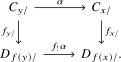 This square is compatible with the projections to \(D\). Evaluating it at \(\id_y\)
and using \(f_{y/}(\id_y)=\id_{f(y)}\) gives
\[
(f_!\alpha)(\id_{f(y)})\simeq f\bigl(\alpha(\id_y)\bigr)
\]
in \(D(f(x),f(y))\). Since \(f\catop\) is the restriction of \(f_!\), the two sides
are precisely the two composites in the asserted square, evaluated on its
universal term. This proves that the square commutes.