Proposition 3.4.5. All of the equivalent conditions from Proposition 3.4.4 are satisfied.
Proof
It will suffice to show that the map \(\geom{[1]} \to *\) is an equivalence. By Proposition 1.4.11, it will suffice to show that for any category \(D\), the induced functor \(D^{\simeq} \simeq \Map(*,D) \to \Map(\geom{[1]},D) \simeq \Map^{\Map([1],[1])}([1],D)\) is an equivalence. Recall from Remark 2.1.29 that the groupoid \(\Map([1],[1])\) is a disjoint union of three points, corresponding to the identity on \(0\), the identity on \(1\), and the canonical map from \(0\) to \(1\) in \([1]\). Spelling out the definition of \(\Map^{\Map([1],[1])}([1],D)\), we obtain a pullback square
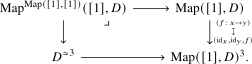 The bottom map is the third power of the embedding \(p_{[1]}^*\colon D^{\simeq}\to\Map([1],D)\). Hence the pullback consists of those morphisms \(f\colon x\to y\) for which \(\id_x\), \(\id_y\), and \(f\) lie in the image of \(p_{[1]}^*\). The first two conditions are automatic, while the third says precisely that \(f\) is an isomorphism. The Rezk equivalence \(D^{\simeq}\iso\Iso(D)^{\simeq}\) therefore identifies the pullback with \(D^{\simeq}\), compatibly with the displayed map from \(D^{\simeq}\). This proves the claim.