Proposition 12.3.18. Let \(u\colon C\to D\) be a functor between small categories.
We consider the adjunction
\[
u_!\colon\PSh(C)\rightleftarrows\PSh(D)\noloc u^*,
\]
where \(u^*\) is the functor defined by the rule \(F\mapsto F\circ u\catop\)
and \(u_!\) is the left Kan extension functor along \(u\catop\).
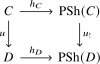
Then there is a canonical commutative square of the form below.
Proof
By Proposition 12.2.3, the functor \(\Tw(u)\) over \(u\catop\times u\) gives, after straightening, a natural transformation \[ \Hom_C\longrightarrow(u\catop\times u)^*\Hom_D. \] Currying gives a natural transformation \(h_C\to u^*h_Du\). Taking its adjunct under the adjunction on \(C\)-indexed functor categories from Proposition 4.4.4 gives a natural transformation \[ \theta\colon u_!h_C\longrightarrow h_Du. \] We will show that \(\theta\) is an isomorphism.
Choose a larger universe in which the two presheaf categories are small. For \(x:C\) and \(F:\PSh(D)\), the Yoneda lemma yields isomorphisms of animae \[ \Hom(h_D(u(x)),F) \simeq F(u(x))=(u^*F)(x) \simeq\Hom(h_C(x),u^*F)\, . \] By adjunction, Proposition 12.1.19 tells us that we also have a canonical equivalence of the form \[ \Hom(h_C(x),u^*F) \simeq \Hom(u_!(h_C(x)),F) \] and thus an identification of the form \[ \Hom(h_D(u(x)),F) \simeq \Hom(u_!(h_C(x)),F) \, . \] This equivalence is precomposition with \(\theta_x\). Indeed, under the adjunction, precomposition sends a natural transformation \(\gamma\colon h_D(u(x))\to F\) to the composite \[ h_C(x)\longrightarrow u^*h_D(u(x))\xrightarrow{u^*\gamma}u^*F. \] The first map sends \(\id_x\) to \(\id_{u(x)}\), by the construction of \(\Tw(u)\). So evaluating this composite at \(\id_x\) gives \(\gamma_{u(x)}(\id_{u(x)})\), which is also the image of \(\gamma\) under the first Yoneda isomorphism above. By applying this construction to the universal object \(\gamma\) in its mapping anima, this identifies the two maps of animae. It follows that precomposition with \(\theta_x\) is an isomorphism for every \(F\), and hence \(\theta_x\) is an isomorphism itself. Isomorphisms in a functor category are detected objectwise, so \(\theta\) is the required natural isomorphism.