Lemma 12.3.9. Both functors \(v\) and \(w\) are initial.
Proof
For \(v\), this is a particular case of Lemma 12.2.7. The proof for \(w\) is similar. Recall from Lemma 9.6.8 that for a commutative square
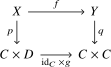 such that \(p\) and \(q\) are left fibrations, if \(f\) is fiberwise initial over \(C\) then \(f\) is initial.
Therefore, in order to show that \(w\) is initial, it will suffice to show that for every object \(x\) of \(C\) (seen as an object of \(C\catop\)), the induced map \(w_x\colon \Tw(C)_x \to W_x\) is initial:
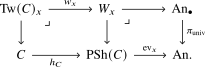 But we already know from Corollary 12.3.5 that \(V_x \simeq W_x\) holds fiberwise, and on fibers
the maps \(v_x\) and \(w_x\) fit into a commutative diagram over \(\PSh(C)\) as follows:
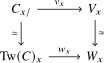 Indeed, to see the commutativity of this square, since the projection of \(W_x\) to \(\PSh(C)\)
is a left fibration, by virtue of Proposition 9.1.13,
it suffices to check that the initial object of \(C_{x/}\) is sent to the same object of \(W_x\)
either way. This amounts to say that, in the equivalence
\[
F(x) \iso \Hom_{\Fun(C,\An)}(h_{C\catop}(x), F)
\]
provided by Corollary 12.3.5, in the case where \(F=h_{C\catop}(x)\),
the identity of \(x\) is sent to the identity of \(h_{C\catop}(x)\). This is true by construction.
Now, since \(v_x\) is initial (see the proof of Lemma 12.2.7), this implies that \(w_x\) is initial as well. This finishes the proof.