Lemma 9.6.8. Consider a commutative square of the form
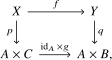 where \(p\) and \(q\) are left fibrations. Assume that \(f\) is fiberwise initial over \(A\), meaning that for every object \(a\) in \(A\), \(f\) induces an initial functor
\[
f_a\colon X_a \to Y_a.
\]
Then \(f\) is initial.
Proof
Since \(q\) is a left fibration, it suffices to check that \(f\) is a covariant equivalence over \(A \times B\), see Proposition 9.2.4. For any object \(b\) of \(B\), we may consider the following commutative square
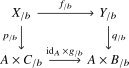 obtained from the above commutative square by pulling back along \(B_{/b} \to B\). For any object \(a\) of \(A\), the commutative square
 induces a commutative square
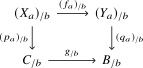 by pulling back along \(B_{/b} \to B\). The top map agrees with the map obtained from
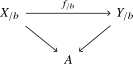 by passing to fibers over \(a\). In particular, \((f_{/b})_a=(f_a)_{/b}\) is a pullback of the initial functor \(f_a\) along a base change of the smooth functor \(B_{/b}\to B\), and hence is initial.
The functor \(X_{/b}\to A\) induced by \(p\) is proper: it is the composite of a left fibration with the proper projection \(A\times C_{/b}\to A\). Pulling back the terminal inclusion of the terminal object in \(A_{/a}\) therefore gives a terminal functor
\[
(X_{/b})_a=(X_a)_{/b}\to (X_{/b})_{/a}=X_{/(a,b)}\, ,
\]
hence a weak homotopy equivalence.
Similarly, the functor \(Y_{/b}\to A\) induced by \(q\) yields a weak homotopy equivalence
\[
(Y_{/b})_a=(Y_a)_{/b}\to (Y_{/b})_{/a}=Y_{/(a,b)}\, .
\]
This means that we have a commutative square of the form
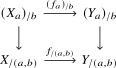 The top horizontal map and both vertical maps are weak homotopy equivalences. Hence 2-out-of-3 shows that \(f_{/(a,b)}\) is a weak homotopy equivalence. Since this holds for every \((a,b)\), Proposition 9.5.6 implies that \(f\) is a covariant equivalence over \(A\times B\), as required.